You open your laptop Monday morning. Twenty-three items stare back at you from a bloated to-do list. A client email needs a reply. The kids need school forms signed. Your side project has a deadline creeping closer. Someone tagged you in a Slack thread that could have been an email.
Everything feels urgent. Nothing gets finished.
That is the reality for millions of professionals, entrepreneurs, freelancers, and students across the country. Traditional to-do lists treat every item as equally important, which means nothing actually gets prioritized. The result is stress, procrastination, and hours lost to low-value busywork that makes you feel productive while moving you nowhere.
The ABCDE Method fixes this. It is a task prioritization framework that forces you to rank every item based on one question: What happens if I don’t do this? The answer separates the work that demands your attention right now from the work you should delay, delegate, or delete entirely.
If you are tired of spinning your wheels, this productivity method will change how you manage your time starting today.
What Is the ABCDE Method?
The ABCDE prioritization method is a simple system for ranking tasks by consequence. It is most commonly associated with time-management author Brian Tracy, who popularized the framework in his books and seminars on personal productivity.
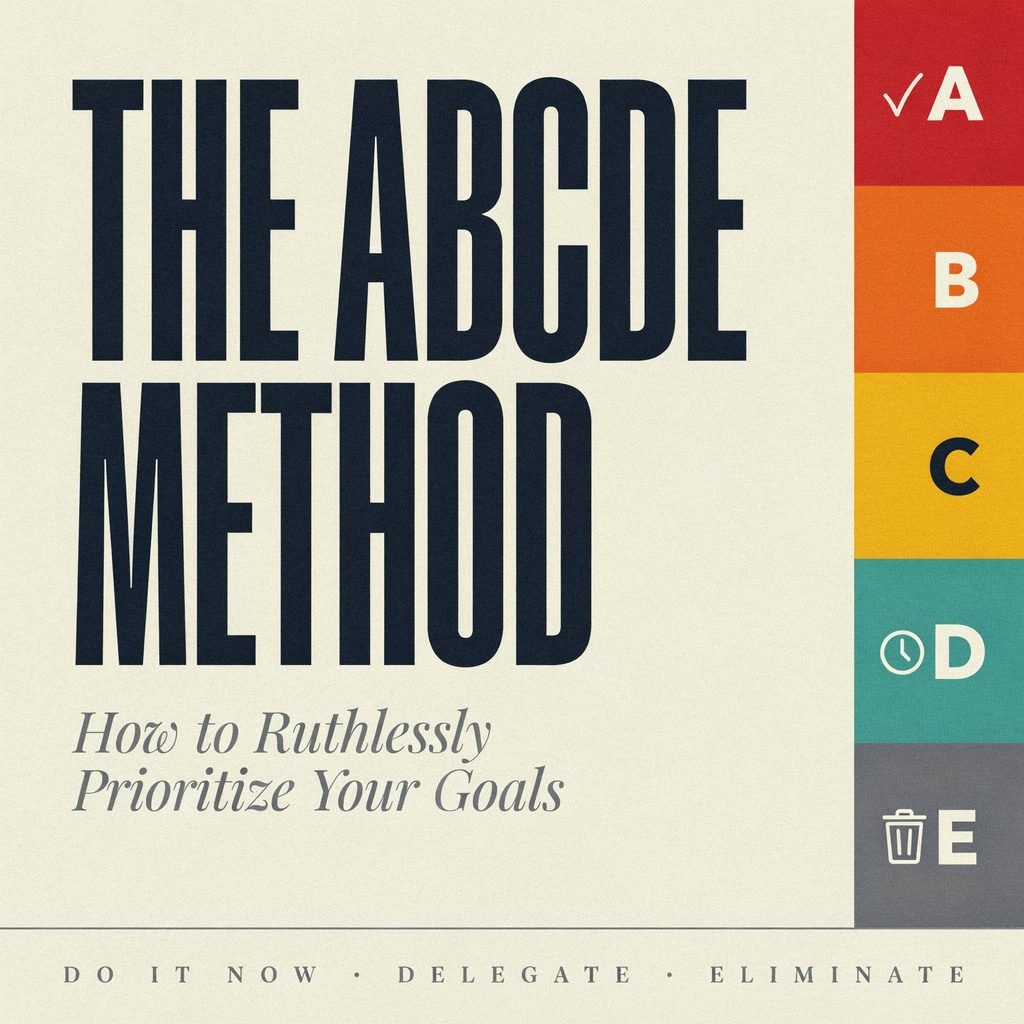
The core principle is straightforward. You assign every task on your list a letter from A to E. An A task carries serious consequences if ignored. An E task carries none. By sorting your daily priority list this way, you stop reacting to whatever screams loudest and start focusing on priorities that actually move your goals forward.
This is not another complicated productivity app or a seventeen-step ritual. It is a five-minute exercise you can do with a pen and a sticky note. And it works because it cuts through decision fatigue by giving you a clear, repeatable rule for how to prioritize tasks.
How the ABCDE Method Works
Here is the framework at a glance:
| Priority | Meaning | Consequence Level | Example |
|---|---|---|---|
| A | Must do | Serious negative outcome if skipped | Submit a client project due today |
| B | Should do | Mild inconvenience if delayed | Plan next week’s content calendar |
| C | Nice to do | No meaningful consequence | Organize desktop files |
| D | Delegate | Someone else can handle it | Schedule social media posts |
| E | Eliminate | Zero value; remove it | Repeatedly checking nonessential notifications |
The beauty of this time management strategy is its honesty. You cannot label everything an A. The system forces you to confront which tasks genuinely matter and which ones are just noise filling your calendar.
A Tasks: Identify the Work That Cannot Wait
A tasks are your high-priority tasks. These are the items where failure to act creates real, tangible consequences. Think missed deadlines that cost you a client. Tax filings that trigger penalties. A medical appointment you keep postponing. A job application window that closes Friday.
To identify your A tasks, ask yourself:
- Is there a hard deadline within the next 24 to 48 hours?
- Will someone lose money, trust, or an opportunity if I skip this?
- Does this involve a legal, financial, or health obligation?
- Is this tied to a major career milestone or strategic planning goal?
Once you have your A tasks, number them. A1 is the single most important item. A2 is second. The rule is non-negotiable: you do not touch A2 until A1 is done. You do not check email, reorganize your desk, or “warm up” with easier work. You start with the hardest, highest-impact task and you finish it.
This is how you reduce procrastination. Not by willpower. By structure.
B Tasks: Important but Not Immediately Critical
B tasks matter for long-term success, but skipping them today will not blow up your week. They carry mild consequences—a small delay, a minor inconvenience, a slightly slower path toward your goals.
Examples include:
- Mapping out a career-development plan for the next quarter
- Scheduling a weekly workout routine
- Building a filing system for business documents
- Having a check-in conversation with a mentor or colleague
- Researching a new skill that supports your growth
The trap with B tasks is treating them like A tasks when they are not, or letting them slide indefinitely because they never feel urgent. The ABCDE Method keeps them visible. You will get to them, but only after your A tasks are complete. That distinction between urgent vs important tasks is where most people lose an entire afternoon.
C Tasks: Enjoyable but Optional Work
C tasks feel productive. They are not. They are the “nice-to-do” activities with no meaningful consequence if they go undone.
Common C tasks include:
- Reorganizing your email folders for the third time this month
- Browsing industry blogs with no specific purpose
- Attending a meeting where your presence adds nothing
- Over-researching a $12 software purchase
- Rearranging your bookshelf or tweaking your desktop wallpaper
None of these are harmful. But when your A tasks are unfinished, C tasks become expensive distractions. They give you the dopamine hit of checking something off without moving you closer to what you actually need to achieve your goals. Label them C, and give yourself permission to skip them on busy days.
D Tasks: Delegate to Protect Your Focus
If you are a business owner, manager, freelancer, or a parent juggling a household, you cannot do everything yourself. D tasks are items that need to happen but do not require your specific skills, authority, or attention.
Examples of tasks you can delegate:
- Booking travel or scheduling appointments (virtual assistant)
- Entering bookkeeping data (accountant or software like QuickBooks)
- Posting pre-written content to social media (scheduling tool like Buffer or a junior team member)
- Grocery shopping or laundry (family member, delivery service)
- Formatting a presentation (colleague or freelance designer)
The key mindset shift: delegation is not laziness. It is a business productivity decision. Every hour you spend on a D task is an hour stolen from an A task. Delegate tasks early, give clear instructions, and let them go.
E Tasks: Eliminate What Does Not Serve Your Goals
E tasks should not exist on your list at all. They are habits, obligations, and distractions that consume time and return nothing.
Look for:
- Mindlessly scrolling social media feeds during work hours
- Attending recurring meetings that have no agenda and no outcome
- Subscribing to newsletters you never open
- Saying yes to favors that drain your energy and align with none of your goals
- Repeatedly checking your phone for notifications that are not actually urgent
Eliminate distractions ruthlessly. Unsubscribe. Decline politely. Automate repetitive work with tools. Turn off nonessential alerts. Every E task you remove clears space for the work that actually matters.
How to Use the ABCDE Method Every Day
Turn this into a daily habit with seven steps:
- Write everything down. Dump every task, errand, email, and obligation onto one list. Do not filter yet.
- Assign a letter. Go through the list and mark each item A, B, C, D, or E based on consequences.
- Number your A and B tasks. Rank them A1, A2, B1, B2, and so on.
- Start with A1. Do not move to A2, B1, or anything else until A1 is complete.
- Delegate D tasks quickly. Send the email, make the call, assign the task. Get it off your plate within minutes.
- Cross out E tasks. Remove them from your schedule. Do not negotiate.
- Reassess daily or weekly. At the end of each day, review what shifted. Carry forward unfinished A tasks. Re-label anything whose consequences changed.
This five-minute routine turns a chaotic to-do list into an effective to-do list you can actually execute.
Real-Life ABCDE Method Example
Meet Sarah, a freelance marketing consultant based in Austin, Texas. It is Wednesday morning, and her plate looks like this:
- Final ad campaign draft due to a client by 3:00 p.m.
- Reply to three client emails asking for minor revisions
- Schedule next week’s LinkedIn posts
- Attend a free webinar on AI copywriting at noon
- Reconcile last month’s business expenses
- Pick up dry cleaning
- Scroll through a competitor’s Instagram for “inspiration”
Sarah applies the ABCDE Method:
- A1: Final ad campaign draft (hard deadline, client revenue on the line)
- B1: Reply to client revision emails (important relationship, but no same-day deadline)
- B2: Reconcile business expenses (needs to happen this week for taxes)
- C: Attend the webinar (interesting, but recorded versions will be available)
- D: Schedule LinkedIn posts (hand off to her scheduling tool or VA)
- D: Pick up dry cleaning (ask her partner to grab it on his way home)
- E: Scrolling a competitor’s Instagram (no deliverable, no deadline, pure distraction)
By 3:15 p.m., Sarah has delivered the campaign, replied to two emails, and delegated the rest. She protected her focus on priorities instead of drowning in a flat, unranked list.
Common Mistakes to Avoid
Even a simple productivity framework can fail if you misuse it. Watch for these pitfalls:
- Labeling everything A. If every task is urgent, none of them are. Limit yourself to one to three A tasks per day.
- No clear goals behind the list. The ABCDE Method works best when it supports specific goal setting. Know what you are building toward.
- Refusing to delegate. Thinking “I’ll do it faster myself” keeps you stuck on D tasks forever.
- Confusing easy with important. Answering a quick email feels good. It is not the same as finishing the proposal that pays your rent.
- Never reviewing the list. Priorities shift. A B task can become an A task overnight. Reassess regularly.
Benefits of the ABCDE Prioritization Method
When you commit to this system, the results compound:
- Sharper focus. You know exactly where to start each morning.
- Better time management. Hours stop leaking into low-value work.
- Less decision fatigue. The framework decides for you, so your brain can execute.
- Reduced procrastination. Starting is easier when the first task is already chosen.
- Stronger goal achievement. Daily actions align with long-term objectives.
- Higher productivity without burnout, because you are doing fewer things that matter more.
- Improved work-life balance. Finishing your A tasks by early afternoon means you can actually log off and be present with your family.
This is not about hustle culture. It is about personal productivity that respects your time, your energy, and your life outside of work.
Conclusion
Productivity is not about cramming more tasks into your day. It is about doing the two or three tasks that carry the greatest consequences and letting the rest wait, shift, or disappear.
The ABCDE Method gives you a repeatable, honest way to prioritize your to-do list every single morning. No apps required. No complex setup. Just a list, five letters, and the discipline to start with A1.
Try it for one full week. Write your list tonight. Label it tomorrow morning. Work through it in order. At the end of seven days, compare your progress to the previous week. You will likely find that you accomplished more meaningful work in fewer hours—and felt less stressed doing it.
Your goals are not going to achieve themselves. But with the right prioritization method, you will finally stop being busy and start being effective.
Grab a pen. Write the list. Assign the letters. Start with A1.
Frequently Asked Questions
What is the ABCDE Method for prioritizing tasks?
The ABCDE Method is a task prioritization system where you label every item on your list from A (must do, serious consequences) to E (eliminate entirely). It helps you focus on high-priority tasks first and remove or delegate low-value work. The method is widely attributed to author and speaker Brian Tracy.
What is the difference between an A task and a B task?
An A task carries serious, immediate consequences if left undone—lost revenue, a missed deadline, a legal issue. A B task is important for long-term success but only creates mild inconvenience if delayed by a day or two. The rule is simple: never start a B task while an A task remains unfinished.
Can the ABCDE Method work for personal goals?
Absolutely. The framework applies to any list of commitments. Use it to prioritize home projects, fitness routines, family obligations, or hobby goals. If skipping a task would genuinely hurt your health, relationships, or finances, it is an A. If it is optional fun, it is a C. The same consequence-based logic holds.
How often should you update your ABCDE priority list?
Review and rebuild your list daily, ideally the night before or first thing in the morning. Do a deeper reassessment once a week—Sunday evening works well for most people—to account for shifting deadlines, new projects, and changing goals. Consistency is what turns this from a one-time exercise into a lasting productivity habit.