Why the 5 A.M. Club Isn’t for Everyone
You’ve seen the headlines: “Billionaires Wake Up at 4:30 A.M.” and “Join the 5 A.M. Club to 10x Your Output.” Yet for millions of Americans, dragging themselves out of bed before dawn doesn’t unlock genius—it unlocks brain fog, resentment, and a mid-morning crash that no amount of espresso can fix.
The truth? Your biology isn’t broken. You’re simply working against your chronotype—your genetically wired sleep-wake preference.
The chronotype productivity method is a science-backed framework that aligns your work, sleep, exercise, and daily habits with your internal biological clock so you can achieve peak performance hours by chronotype rather than by arbitrary cultural pressure.
Consider this: the CDC reports that more than 1 in 3 US adults regularly sleep fewer than seven hours per night, while Gallup’s 2024 workplace survey found that 44% of American workers experienced burnout the previous day. Much of that exhaustion stems from forcing a one-size-fits-all schedule onto bodies wired differently.
By the end of this guide, you’ll know your chronotype type and have a customized daily plan ready to implement tomorrow morning—or evening.
What Is a Chronotype? The Science Behind Your Body Clock
A chronotype is your body’s natural inclination toward sleeping and waking at particular times, governed by your circadian rhythm—the roughly 24-hour internal clock regulated by the suprachiasmatic nucleus in your hypothalamus.
Think of it this way: your circadian rhythm is the orchestra conductor, and your chronotype is whether that orchestra plays a sunrise symphony or a midnight jazz set.
The Biology in Plain Language
- Melatonin signals your brain to wind down and prepare for sleep.
- Cortisol surges in the morning to promote alertness and focus.
- The PER3 gene (and related clock genes like CLOCK and BMAL1) largely determines whether you’re a natural early riser or night owl.
Critically, a chronotype is not a habit you can “discipline” away. It is a biological clock and focus pattern encoded in your DNA. Choosing to stay up late because of Netflix is a lifestyle choice; feeling genuinely wired at 11 p.m. and groggy at 6 a.m. is a chronotype signal.
Dr. Michael Breus and the Four Animal Archetypes
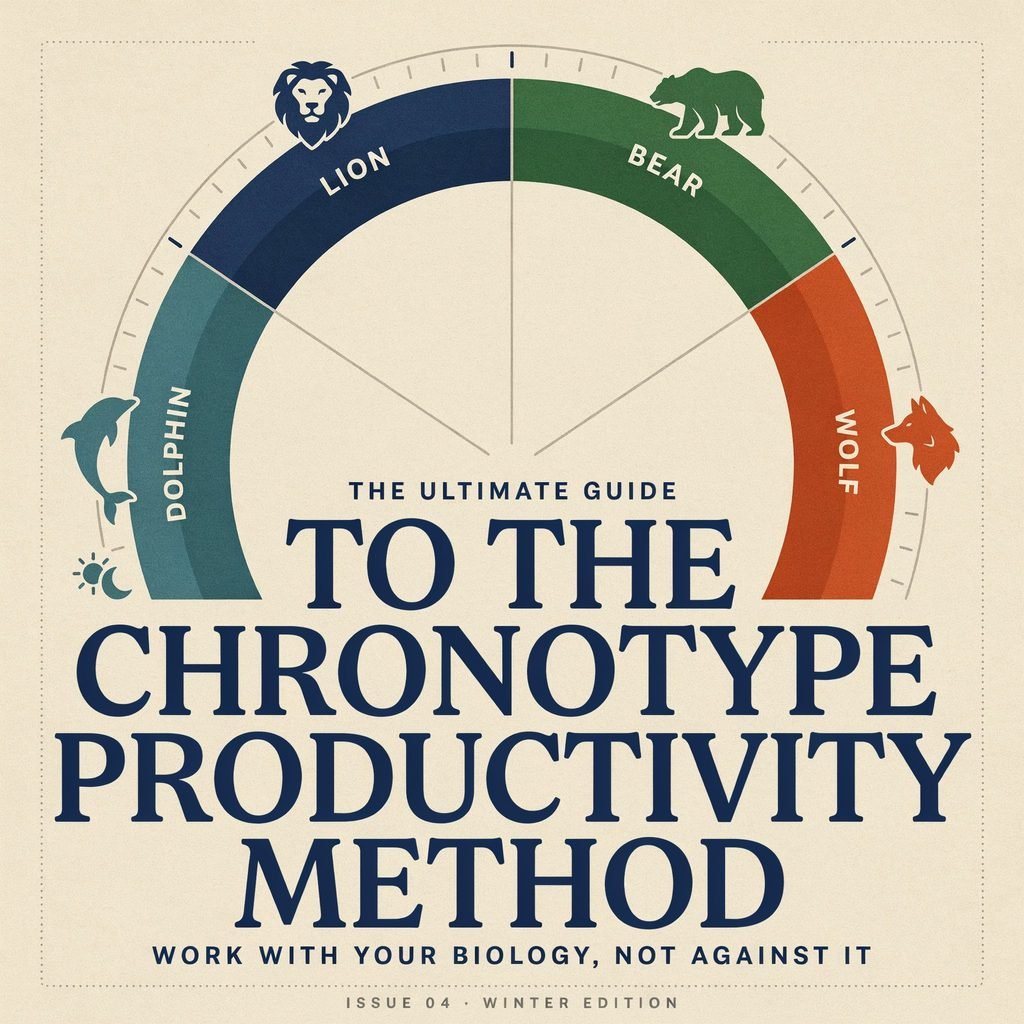
Clinical psychologist Dr. Michael Breus popularized the Michael Breus chronotype method in his book The Power of When, replacing the outdated “morning person vs. night owl” binary with four animal-based archetypes—Lion, Bear, Wolf, and Dolphin—each reflecting distinct patterns of energy, alertness, and rest.
The Four Chronotypes: Lion, Bear, Wolf, and Dolphin
Understanding the Lion, Bear, Wolf, Dolphin chronotypes is the foundation of the chronotype productivity method. Here’s how each type breaks down in a US context.
🦁 Lion (Early Bird) – ~15–20% of the population
- Wake time: 5:30–6:00 a.m. (often before the alarm)
- Peak productivity: 8:00 a.m.–12:00 p.m.
- Energy trough: 2:00–4:00 p.m.
- Ideal bedtime: 9:30–10:30 p.m.
- Traits: Conscientious, goal-oriented, thrives in structured corporate or entrepreneurial environments. Lions dominate early-morning meetings and often lead teams.
🐻 Bear – ~50–55% of the population
- Wake time: 7:00–7:30 a.m.
- Peak productivity: 10:00 a.m.–2:00 p.m.
- Energy trough: 2:30–4:30 p.m. (the classic post-lunch dip)
- Ideal bedtime: 10:30–11:30 p.m.
- Traits: Social, steady, adaptable. Bears sync well with the traditional US 9-to-5 schedule and make up the majority of the workforce.
🐺 Wolf (Night Owl) – ~15–20% of the population
- Wake time: 8:00–9:00 a.m. (often later on weekends)
- Peak productivity: 4:00 p.m.–8:00 p.m., with a second wind around 10:00 p.m.
- Energy trough: Late morning (before 11 a.m.)
- Ideal bedtime: 12:00–1:00 a.m.
- Traits: Creative, introspective, risk-tolerant. Wolves excel in design, writing, tech development, and any field rewarding unconventional thinking.
🐬 Dolphin (Light Sleeper) – ~10% of the population
- Wake time: 6:00–6:30 a.m. (but sleep is fragmented)
- Peak productivity: 3:00 p.m.–9:00 p.m. (variable)
- Energy trough: Mid-morning and late night
- Ideal bedtime: 11:30 p.m.–12:00 a.m. (though falling asleep is difficult)
- Traits: Detail-oriented, perfectionist, prone to anxiety and insomnia. Named for dolphins because, like dolphins, they sleep with “half a brain” alert.
Quick-Reference Comparison Table
| Feature | 🦁 Lion | 🐻 Bear | 🐺 Wolf | 🐬 Dolphin |
|---|---|---|---|---|
| % of US pop. | 15–20% | 50–55% | 15–20% | ~10% |
| Wake time | 5:30–6:00 a.m. | 7:00–7:30 a.m. | 8:00–9:00 a.m. | 6:00–6:30 a.m. |
| Peak hours | 8 a.m.–12 p.m. | 10 a.m.–2 p.m. | 4 p.m.–8 p.m. | 3 p.m.–9 p.m. |
| Trough | 2–4 p.m. | 2:30–4:30 p.m. | Before 11 a.m. | Mid-morning |
| Ideal bedtime | 9:30–10:30 p.m. | 10:30–11:30 p.m. | 12–1 a.m. | 11:30 p.m.–12 a.m. |
How to Find Your Chronotype
Wondering how to find your chronotype? You don’t need a sleep lab. Start with these self-assessment questions:
- No-alarm test: On a free day (vacation or long weekend), what time do you naturally wake without an alarm?
- Peak focus check: When do you feel sharpest for analytical or creative work—before noon, mid-afternoon, or after 6 p.m.?
- Ideal bedtime: If you had zero obligations, when would you choose to fall asleep?
- Energy crash: When do you hit your worst slump?
You can also take a sleep chronotype test online—Dr. Breus’s official quiz at thepowerofwhen.com takes about five minutes and maps your answers to one of the four types.
A few caveats:
- Chronotypes can shift slightly with age (teens skew Wolf; older adults skew Lion).
- Seasonal changes, shift work, and parenting can mask your true type temporarily.
- If you suspect a sleep disorder, consult a board-certified sleep physician rather than relying solely on a quiz.
The Chronotype Productivity Method: A Step-by-Step System
Identifying your type is step one. The real power of the chronotype productivity method lies in building your day around it. Here’s how.
5.1 Map Your Peak, Trough, and Recovery Windows
Every chronotype cycles through three cognitive zones each day:
- Peak: Highest alertness, focus, and willpower. Reserve this for deep work by chronotype—strategic thinking, writing, coding, analysis.
- Trough: Lowest energy and cognitive sharpness. Use it for low-stakes admin, email triage, errands, or a short walk.
- Recovery: Mood lifts but analytical focus softens. Ideal for brainstorming, creative problem-solving, and collaborative ideation.
Matching task type to window is the single highest-leverage energy management by chronotype strategy you can adopt.
5.2 Design a Chronotype-Aligned Daily Schedule
Below is a chronotype schedule template skeleton for each type. Adjust times by ±30 minutes to fit your life.
Lion Schedule
- 5:30 a.m. – Wake, hydrate, 10 min light exposure
- 6:00–8:00 – Deep work block #1 (highest-value project)
- 8:00–12:00 – Meetings, collaborative work, second deep block
- 12:00–1:00 – Lunch + walk
- 1:00–3:00 – Admin, email, routine tasks (trough)
- 3:00–5:00 – Creative brainstorming, light project work
- 5:30–6:30 – Exercise
- 9:30 p.m. – Wind-down, lights dim
Bear Schedule
- 7:00 a.m. – Wake, sunlight, breakfast
- 10:00 a.m.–2:00 p.m. – Deep work + key meetings (peak)
- 2:30–4:00 – Admin, calls, lighter tasks (trough)
- 4:00–5:30 – Creative or collaborative work (recovery)
- 6:00–7:00 – Exercise
- 10:30 p.m. – Wind-down routine
Wolf Schedule
- 8:30 a.m. – Wake, gentle movement, no screens for 20 min
- 9:00–11:00 – Light admin, email, planning (low-energy morning)
- 12:00–1:00 – Lunch + walk
- 4:00–8:00 p.m. – Primary deep work and creative blocks (peak)
- 9:00–10:00 – Exercise or social time
- 12:00 a.m. – Wind-down, blue-light filters on
Dolphin Schedule
- 6:00 a.m. – Wake, grounding exercise (breathwork, stretching)
- 7:00–9:00 – Light movement, planning, low-pressure tasks
- 3:00–9:00 p.m. – Core work block split into 90-min segments
- 10:00 p.m. – Strict wind-down: no screens, cool room, relaxation technique
- Keep caffeine before 1:00 p.m. to protect chronotype and sleep quality
Use chronotype-based time blocking in your calendar tool of choice—color-code peak, trough, and recovery zones so the visual cue keeps you honest.
5.3 Optimize Sleep, Light, and Caffeine Timing
- Morning light: Get 10–15 minutes of direct sunlight within an hour of waking. This anchors your circadian rhythm and productivity cycle.
- Caffeine: Delay your first cup to roughly 90 minutes after waking. This lets your natural cortisol spike do the heavy lifting first and prevents the afternoon crash.
- Evening wind-down: Dim lights 60–90 minutes before your target bedtime. Lions may start at 8 p.m.; Wolves closer to 10:30 p.m. Build an evening routine for chronotypes that signals safety to your nervous system—reading, gentle stretching, or a warm shower.
5.4 Task Matching: Do the Right Work at the Right Time
| Window | Best Tasks | Avoid |
|---|---|---|
| Peak | Strategy, writing, coding, financial analysis | Mindless email, social media |
| Trough | Data entry, filing, scheduling, errands | High-stakes decisions, creative pitches |
| Recovery | Brainstorming, design exploration, networking calls | Rote spreadsheet work |
For remote workers: If your company runs on East Coast hours but you’re a Wolf on the West Coast, negotiate asynchronous blocks. Protect your 4–8 p.m. peak for deep work and batch meetings into late morning.
For entrepreneurs: You have maximum scheduling freedom—use it. Build your chronotype-friendly work schedule around revenue-generating tasks during peak hours and delegate or automate trough-hour admin.
5.5 Adjust for Real-World Constraints
Not everyone can redesign their day from scratch. If you’re locked into a 9-to-5, have kids to manage, or coordinate across US time zones:
- Protect at least one 90-minute peak block. Guard it like a meeting with your most important client.
- Negotiate flex hours. Frame it around output: “I deliver my best analysis between 10 and 2—can I shift my start by an hour?”
- Use micro-adjustments. A 15-minute walk during your trough can restore enough focus to finish the afternoon.
- Batch meetings into your recovery or trough windows so they don’t cannibalize peak time.
Chronotype-Specific Tips for Diet, Exercise, and Mental Health
Chronotype Diet and Exercise Timing
- Lions benefit from a protein-rich breakfast by 6:30 a.m. and should aim for moderate-intensity exercise (running, cycling) before 8 a.m. or in the late afternoon.
- Bears align well with a standard three-meal schedule. Schedule workouts between 12 and 4 p.m. when body temperature and coordination peak.
- Wolves often skip breakfast; a lighter mid-morning meal works better. Evening workouts (6–8 p.m.) match their natural energy surge.
- Dolphins should avoid heavy meals within three hours of bedtime. Gentle yoga or swimming in the late afternoon reduces nervous-system arousal.
Chronotype and Mental Health
- Dolphins are most susceptible to anxiety and insomnia. Cognitive-behavioral techniques for insomnia (CBT-I) and consistent sleep hygiene are critical.
- Wolves in traditional 9-to-5 roles report higher rates of “social jet lag”—the mismatch between biological and social schedules—which correlates with low mood and irritability.
- All types benefit from protecting chronotype and work-life balance boundaries: set a hard stop time, turn off Slack notifications, and honor your wind-down window.
According to the Sleep Foundation, aligning daily activities with your circadian rhythm can improve both sleep quality and daytime alertness within two to three weeks.
Common Mistakes and How to Avoid Them
Even well-intentioned professionals sabotage their chronotype productivity method with these errors:
- Fighting your biology. A Wolf forcing a 5 a.m. “hustle culture” routine will accumulate sleep debt and cognitive drag within days. Work with your wiring.
- Inconsistent sleep schedules. Shifting bedtimes by more than 30 minutes between weekdays and weekends disrupts your circadian rhythm and productivity cycle.
- Overloading peak windows with meetings. If your peak is 10 a.m.–2 p.m., that calendar should show deep work blocks—not back-to-back Zoom calls.
- Ignoring light and caffeine timing. Blue-light exposure at midnight or a 4 p.m. latte can delay melatonin release by hours, especially for Dolphins and Wolves.
- Treating your chronotype as a life sentence. You can nudge your schedule 30–60 minutes with consistent light exposure and routine, but you can’t overhaul your genetics. Aim for optimization, not transformation.
Tools, Apps, and Resources to Support Your Chronotype
- Sleep trackers: Oura Ring, Whoop, or Apple Watch sleep stages help confirm whether your real sleep architecture matches your perceived chronotype.
- Light therapy lamps: A 10,000-lux box (e.g., Carex or Verilux) is invaluable for Wolves and Dolphins who struggle with morning alertness in darker US winters.
- Calendar templates: Use Notion, Google Calendar, or a printable chronotype schedule template to color-code peak, trough, and recovery blocks. (Consider offering a free downloadable PDF here as a lead magnet.)
- Habit and focus apps: Forest, Todoist, or Sunsama let you time-block tasks to your energy windows.
- Further reading: Dr. Michael Breus’s The Power of When and the National Institutes of Health circadian rhythms overview are excellent next steps.
Conclusion: Work With Your Biology, Not Against It
The chronotype productivity method isn’t another hack or hustle trend. It’s a permission slip to stop fighting the body you were born with and start scheduling the work you actually do best during the hours your brain is genuinely ready for it.
In a culture that still glorifies the pre-dawn grind, choosing to do your sharpest analytical work at 5 p.m. because you’re a Wolf—or protecting your 9:30 p.m. bedtime because you’re a Lion—isn’t laziness. It’s strategy.
Here’s your one action step for this week: Take a five-minute sleep chronotype test, identify whether you’re a Lion, Bear, Wolf, or Dolphin, and rearrange just one deep-work block to land in your true peak window. Notice the difference.
Then come back and share your chronotype in the comments—tell us what changed when you finally stopped swimming upstream. And if you want a ready-made daily plan, download the free chronotype schedule template linked above.
Your biology already knows when you’re at your best. It’s time your calendar caught up.