Your alarm blares at 6:30 AM, but you hit snooze. By the time you finally drag yourself out of bed, you’re already twenty minutes behind. You spill coffee on your shirt, rush out the door, and open your laptop to find 47 unread emails staring back at you. Before you’ve even taken your first sip of coffee, the day feels completely out of control.
If this chaotic scenario sounds familiar, you are not alone. Millions of busy professionals, freelancers, and parents start every single day feeling like they are already losing the race. The cost of poor time management isn’t just missed deadlines; it’s chronic stress, burnout, and missed family dinners.
But it doesn’t have to be this way. Taking control of your schedule doesn’t require waking up at 4:00 AM or working eighty-hour weeks. It simply requires a few practical, low-friction strategies. In this guide, we will explore how to take control of your daily schedule by focusing on four key pillars: clarifying priorities, planning with purpose, protecting your time, and tracking your habits.
Why Time Management Matters
Why does mastering your schedule matter so much? Simply put, effective time management is the foundation of a healthy, productive life. When you manage your hours intentionally, you reduce daily stress and create space for the things that truly matter. You stop reacting to emergencies and start proactively achieving your goals.
Research consistently shows that poor scheduling takes a massive toll on our brains. For instance, studies from the University of California, Irvine, reveal that it takes an average of 23 minutes to fully regain focus after a single interruption. If you are constantly checking emails or answering quick questions, your brain never reaches a state of deep focus.
Beyond just getting more work done, learning to manage time effectively dramatically improves your work-life balance. It protects your mental health by creating firm boundaries between your professional obligations and your personal downtime. When you finish your work efficiently, you can actually log off and enjoy your evening without that nagging guilt. Better focus leads to better results, and better results lead to more genuine free time.
How to Take Control of Your Daily Schedule: The 4 Pillars
To build a sustainable routine, we need to move past generic productivity tips and focus on actionable systems. Let’s break down the four core pillars of a highly effective daily routine.
Pillar 1: Clarify Your Priorities
Before you can organize your day, you need to know what actually deserves your attention. A massive to-do list is useless if every task seems equally important. This is where learning to prioritize tasks becomes your superpower.
The secret lies in understanding the difference between what is urgent and what is important. Urgent tasks demand immediate attention, like a ringing phone or a crying toddler. Important tasks contribute to your long-term mission, like writing a strategic business plan or exercising.
To separate the two, use the famous Eisenhower Matrix. This simple framework forces you to categorize every item on your plate into four quadrants: Do First (urgent and important), Schedule (important, not urgent), Delegate (urgent, not important), and Delete (neither). Once you understand this distinction, you can identify your Most Important Tasks (MITs).
Your MITs are the one to three things that, if completed today, would make the day a massive success. Here is a simple step-by-step process to clarify your daily focus:
- Brain dump: Write down absolutely every task, errand, and project currently on your mind.
- Categorize: Mark each item using the Eisenhower Matrix to filter out the noise.
- Select your MITs: Choose the top three important tasks that align with your long-term goal setting.
- Schedule them: Assign specific time blocks to tackle these MITs first thing in the morning.
Imagine a freelance content creator planning their week. They have a client article due (urgent and important), a website SEO audit (important but not urgent), and a dentist appointment for their child (urgent). By identifying the client article and the SEO audit as their MITs, they ensure high-value work gets done before the daily chaos begins.
Micro-action: Tonight, take five minutes to pick tomorrow’s three MITs. Write them at the very top of your planner system or digital notepad.
Pillar 2: Plan Your Day With Purpose
Once you know your priorities, it is time to give them a home on your calendar. Relying solely on a mental to-do list is a recipe for disaster. Instead, adopt a calendar-first approach using a powerful strategy called time blocking.
Time blocking involves dividing your day into distinct blocks of time, each dedicated to a specific task or category of work. This method transforms your abstract to-do list into a concrete action plan. You aren’t just deciding what to do; you are deciding exactly when you will do it.
To maximize your focus techniques, combine time blocking with task batching. Task batching means grouping similar, low-energy tasks together. Instead of checking email every ten minutes, batch all your administrative work into a single 45-minute block in the afternoon.
For your most demanding MITs, utilize the Pomodoro technique. This involves working in highly focused 25-minute sprints followed by a 5-minute break. After four cycles, you take a longer 15-minute break. It keeps your brain fresh and prevents the mental fatigue that usually hits around 2:00 PM.
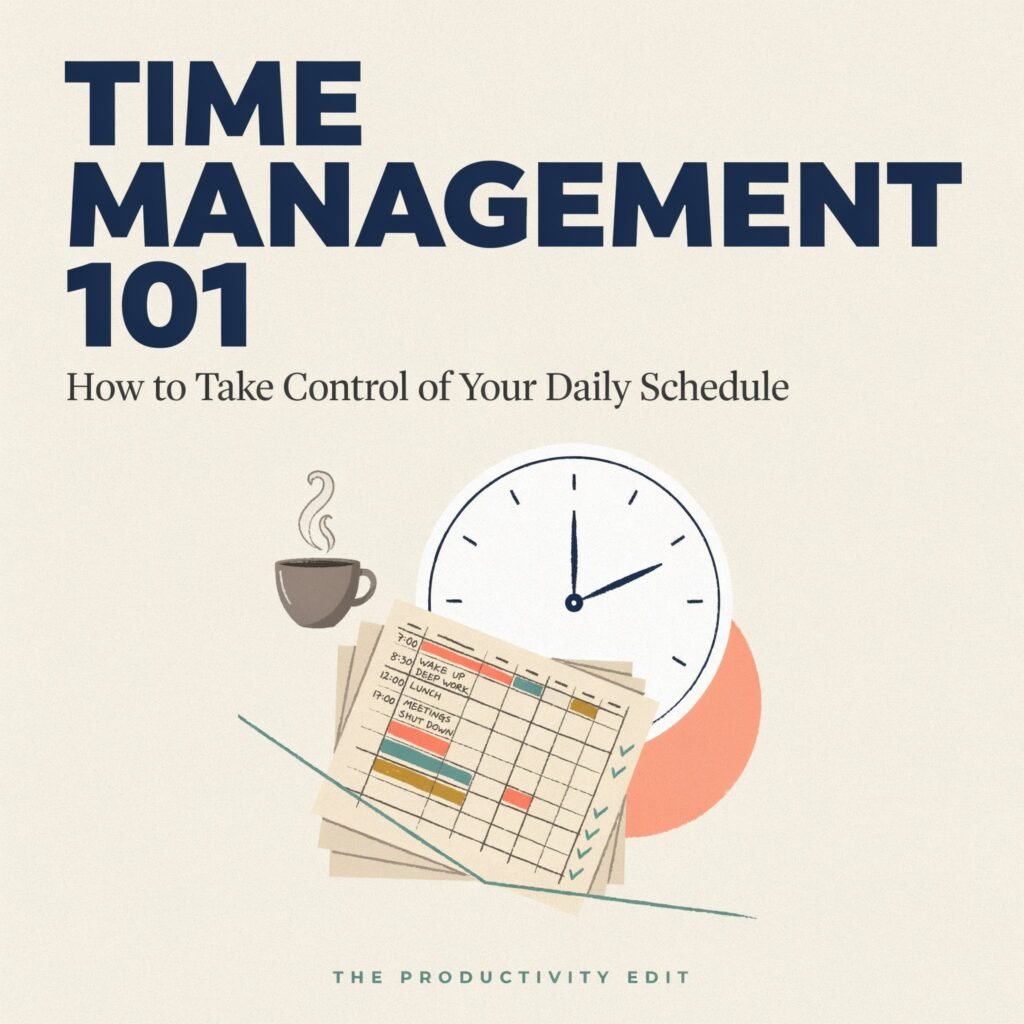
Here is what a highly effective, time-blocked daily schedule might look like for a hybrid remote worker:
- 7:00 AM – 8:00 AM: Mindful morning routine (exercise, breakfast, zero screens).
- 8:00 AM – 8:30 AM: Review daily plan, check urgent messages, and prep workspace.
- 8:30 AM – 10:30 AM: Deep Work Block 1 (Tackle MIT #1 using Pomodoro sprints).
- 10:30 AM – 11:00 AM: Break, stretch, and grab a coffee.
- 11:00 AM – 12:00 PM: Meetings and collaborative calls.
- 12:00 PM – 1:00 PM: Lunch break (step away from the desk).
- 1:00 PM – 2:30 PM: Deep Work Block 2 (Tackle MIT #2 and MIT #3).
- 2:30 PM – 3:30 PM: Task batching (emails, Slack replies, and admin work).
- 3:30 PM – 4:00 PM: End-of-day review and plan tomorrow’s MITs.
Notice how this schedule includes built-in breaks and buffer times. This flexibility is crucial for maintaining your energy management throughout the day.
Micro-action: Look at your calendar for tomorrow. Block out two 90-minute deep work sessions for your MITs, and schedule a 15-minute review at the end of the day.
Pillar 3: Protect Your Time
You can build the most beautiful schedule in the world, but it means nothing if you let everyone else hijack it. Calendar management is only half the battle; the other half is fiercely guarding your time against digital distractions and unexpected interruptions.
The modern workplace is full of time thieves. Constant Slack notifications, unnecessary meetings, and “quick questions” can easily shred your deep work blocks. To combat this, you must establish firm boundaries and learn to say no politely but firmly.
Start by managing your digital environment. Turn off non-essential push notifications on your phone and desktop. Use “Do Not Disturb” modes aggressively during your deep work blocks. If you work in an office or a busy house, use visual cues like wearing noise-canceling headphones or closing your door to signal that you are in focus mode.
Batch your email checking to specific times, like 11:00 AM and 4:00 PM. Let your colleagues know your communication style so they don’t expect instant replies. When someone tries to book over your deep work time, use these polite but firm scripts to protect your schedule:
- “I’d love to help with this, but my plate is completely full today. Can we revisit this on Thursday?”
- “I’m currently in a deep work sprint and won’t be checking messages until 2 PM. I’ll get back to you then!”
- “I have a hard stop at 3:00 PM today, but I can jump on a quick 10-minute call tomorrow morning.”
Leverage technology to enforce these boundaries. Use scheduling tools like Calendly to prevent meeting overlaps. If you struggle with phone addiction, try focus apps like Forest, which gamifies staying off your device, or use website blockers to lock yourself out of social media during work hours.
Remember, every time you say “yes” to a minor request, you are implicitly saying “no” to your own priorities. Guard your time like it is your most valuable financial asset—because it is.
Pillar 4: Track and Adjust
You cannot improve what you do not measure. Even with the best intentions, we are notoriously bad at estimating how long tasks actually take. This is where time tracking becomes an indispensable tool in your productivity arsenal.
Running a simple time audit for just seven to fourteen days can completely transform your understanding of your own habits. You don’t need to track every single second of your life forever. Just do it briefly to identify your hidden time leaks and understand your natural energy rhythms.
You might discover that writing a weekly newsletter takes you three hours instead of the one hour you budgeted. Or, you might realize that you lose two hours every afternoon to mindless scrolling. Tracking exposes these blind spots so you can fix them.
Fortunately, there are fantastic, low-friction tools available to make this process painless:
- Toggl Track: Excellent for freelancers and professionals who want simple, one-click time tracking across different projects.
- Clockify: A robust, free alternative that offers great reporting features for teams and individuals.
- Built-in Screen Time: Use the native digital wellbeing tools on your iOS or Android device to see exactly how much time you spend on distracting apps.
Once you have a week of data, sit down and analyze it. Look for patterns. When are you most focused? When do you usually hit an energy slump? Use these insights to adjust your time blocks. If you are sharpest at 9:00 AM, move your hardest MIT to that slot.
Micro-action: Commit to running a 7-day time audit starting tomorrow. At the end of the week, note three specific changes you can test the following week to plug your biggest time leaks.
Overcoming Common Time Management Obstacles
Even with a perfect system, you will face days where nothing seems to go right. Anticipating these common roadblocks is the key to maintaining your momentum without burning out. Let’s look at some practical procrastination hacks and strategies for tough days.
When you feel paralyzed by a massive project, rely on quick psychological tricks to get moving. Here are a few reliable methods to beat procrastination and manage low-energy days:
- The 2-Minute Rule: Tell yourself you will only work on the task for two minutes. Usually, the friction is just in starting. Once you open the document and write one sentence, momentum takes over.
- Eat the Frog (or Don’t): If you are paralyzed by a hard task, start with the absolute easiest step just to build momentum.
- Maintenance Mode: On low-energy days, do not force deep work. Shift your focus to organizing files, clearing out your inbox, or doing basic research.
- The “Good Enough” Threshold: Combat perfectionism by setting strict time limits. Give yourself exactly one hour to draft a proposal, and accept “done” over “perfect.”
Finally, if you work from home with family, overlap is inevitable. Create shared family calendars so everyone knows your busy blocks. Build 15-minute buffer times between your meetings to handle unexpected kid emergencies or household chores.
Mini Case Study: Sarah’s Transformation
Meet Sarah, a freelance content creator and mother of two toddlers. Before discovering solid time management strategies, her days were a blur of half-written articles and interrupted playtime. She felt constantly behind, checking emails during family dinners and writing blog posts at midnight.
Then, she implemented the “Top 3 MITs” rule alongside strict time blocking. Every evening, she wrote down her three Most Important Tasks for the next day. During her morning deep work block, she closed her office door, put her phone in another room, and focused solely on writing.
Within two weeks, Sarah’s output doubled, but more importantly, her stress plummeted. By knowing exactly when she would work and when she would be fully present with her kids, she finally achieved the work-life balance she had been craving.
Tools, Templates, and Resources
You don’t need a complicated setup to succeed. A reliable planner system and a few key digital tools are all you need to execute the strategies we’ve discussed. Whether you prefer pen and paper or digital dashboards, consistency is your ultimate goal.
If you love the tactile feel of writing things down, invest in a high-quality paper planner like the Passion Planner or a simple dot-grid notebook. If you prefer digital, tools like Notion, Todoist, or TickTick are incredible for managing complex lists. When exploring different to-do list strategies, finding the one that fits your brain is key. For more software recommendations, check out our guide on the best productivity apps.
To get you started immediately, here is a quick, repeatable template for your daily planning ritual:
- Top 3 MITs: Write down the three non-negotiable tasks for the day.
- Time Blocks: Assign specific hours on your calendar for deep work, meetings, and admin.
- Brain Dump List: A secondary list for smaller, low-priority tasks to tackle during energy slumps.
- End-of-Day Review: A 10-minute checklist to clear your inbox, tidy your desk, and plan tomorrow.
Pair this daily template with a solid weekly review every Sunday evening. This 30-minute ritual ensures your daily MITs are actually rolling up toward your larger monthly and yearly goals.
Take Control of Your Schedule Today
Mastering your schedule is not about squeezing more work into every waking second. It is about creating a sustainable rhythm that allows you to do your best work while still enjoying your life. True productivity gives you the freedom to log off and be fully present with the people you love.
Don’t try to implement every single strategy in this guide all at once. Pick just one change—like identifying your daily MITs or trying time blocking—and commit to it for the next seven days. Once that feels like a natural habit, layer in another technique.
What is your biggest daily time-waster, or what is your favorite focus tactic? Share your thoughts in the comments below! If you want to optimize the rest of your day, read our morning routine tips to start your day right, or grab our free daily planner printable to map out your success.