Imagine this: It’s 4:00 PM on a Tuesday. You’re working from your home office, the kids are doing homework at the kitchen table, and you have a side project deadline looming. You look at your to-do list and realize you’ve spent the last three hours answering emails and putting out minor fires. The most important tasks? Barely touched. Sound familiar?
If you’re nodding your head, you aren’t alone. In our fast-paced, always-on American work culture, figuring out how to manage time effectively feels like an impossible puzzle. But here’s the good news: time management isn’t about squeezing every second out of your day until you’re exhausted. It’s about working smarter, not harder.
At its core, time management is the process of organizing and planning how to divide your time between specific activities. Good time management enables you to work smarter—not harder—so that you get more done in less time, even when time is tight and pressures are high. For time management for beginners, the goal is simple: boost your productivity, drastically reduce stress, and finally achieve that elusive work-life balance.
In this masterclass, we will strip away the complex theories and focus on practical, actionable productivity tips. By the end, you’ll have a clear roadmap to take control of your schedule, protect your energy, and build lasting routines. Let’s dive in!
Core Concepts: The Foundations of Taking Control
Before we jump into specific time-saving strategies, we need to understand the foundational concepts that make time management work. Think of these as the bedrock of your new daily routine.
Prioritization
Not all tasks are created equal. Prioritizing tasks means identifying what truly moves the needle in your career and personal life, and tackling those first. If you treat answering a casual Slack message with the same urgency as finishing a quarterly report, you’ll inevitably fall behind.
Planning
Winging it rarely works. Effective schedule planning involves looking ahead—daily, weekly, and monthly—to anticipate roadblocks and allocate your energy where it’s needed most. A few minutes of planning the night before can save you hours of decision fatigue the next day.
Focus
We live in an economy of distraction. True focus means dedicating your uninterrupted attention to a single task. When you master focus techniques, you’ll find that a task that usually takes two hours of distracted work can be completed in forty-five minutes of deep concentration.
Boundary-Setting
You cannot manage your time if you let everyone else manage it for you. Learning to set boundaries is crucial. This means communicating your availability to coworkers, protecting your personal time from work creep, and guarding your focus against digital interruptions.
To help you master these concepts, let’s look at two classic models in plain English:
The Eisenhower Matrix
Named after former US President Dwight D. Eisenhower, this model helps you prioritize tasks by urgency and importance. It divides tasks into four boxes: Do first (urgent and important), Schedule (important, not urgent), Delegate (urgent, not important), and Delete (neither). It’s a game-changer for clearing out busywork.
Parkinson’s Law
This adage states that “work expands so as to fill the time available for its completion.” If you give yourself a week to write a simple blog post, it will take a week. If you give yourself two hours, you’ll likely finish it in two hours. Understanding this law is the secret to beating procrastination and creating artificial deadlines to boost your efficiency.
Practical Techniques: Your Step-by-Step Toolkit
Now that you understand the “why,” let’s get into the “how.” Here are eight practical time management tips you can implement today.
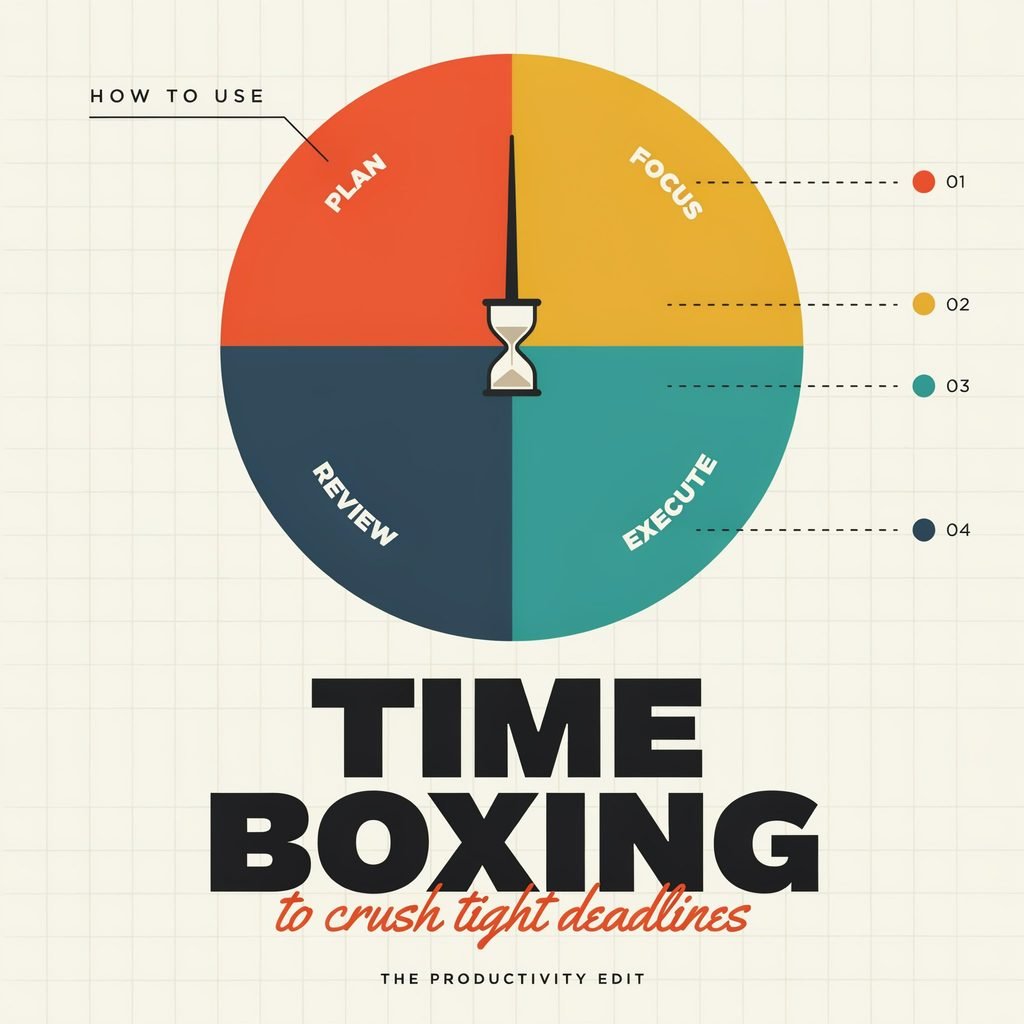
1. Time Blocking
- What it is: Dividing your day into blocks of time, each dedicated to a specific task or group of tasks.
- Why it works: It prevents tasks from bleeding into one another and forces you to be intentional with your schedule.
- How to do it: Open your calendar and block out 9:00 AM to 11:00 AM for “Deep Work,” 11:00 AM to 11:30 AM for “Emails,” and so on. Treat these blocks like unbreakable appointments with yourself. This is the foundation of effective time blocking.
2. The Pomodoro Technique
- What it is: A time management method that uses a timer to break work into intervals, traditionally 25 minutes in length, separated by short breaks.
- Why it works: It creates a sense of urgency and keeps your brain fresh, making it one of the best focus techniques for beginners.
- How to do it: Pick a task, set a timer for 25 minutes, and work with zero distractions. When the timer rings, take a 5-minute break. After four “Pomodoros,” take a longer 15-30 minute break.
3. Batching Tasks
- What it is: Grouping similar, low-energy tasks together and doing them all at once.
- Why it works: It reduces the mental fatigue of switching gears.
- How to do it: Instead of checking email every 10 minutes, batch your inbox checks to 9:00 AM, 1:00 PM, and 4:00 PM. Do all your phone calls or administrative paperwork in one designated batch.
4. Using the Eisenhower Matrix
- What it is: Applying the four-quadrant system mentioned in the core concepts to your actual to-do list.
- Why it works: It visually separates high-impact work from trivial distractions.
- How to do it: Every morning, write down your tasks and place them in the Do, Schedule, Delegate, or Delete quadrants. Focus 80% of your energy on the “Do” and “Schedule” boxes. The Eisenhower Matrix is vital for learning how to prioritize tasks effectively.
5. Setting SMART Goals
- What it is: Creating goals that are Specific, Measurable, Achievable, Relevant, and Time-bound.
- Why it works: Vague goals like “work on side project” lead to vague results. SMART goals provide a clear finish line.
- How to do it: Change “work on side project” to “Write the first 500 words of my eBook chapter by 5:00 PM on Thursday.”
6. Planning Weekly Reviews
- What it is: Dedicating 30 minutes at the end of the week to reflect and plan.
- Why it works: It closes open loops in your brain and sets you up for a successful Monday.
- How to do it: Every Friday afternoon, review what you accomplished, clear out your physical and digital workspaces, and map out your top three priorities for the upcoming week. This weekly review is a staple among highly productive professionals.
7. Limiting Context Switching
- What it is: Stopping the habit of jumping between unrelated tasks (e.g., writing a report, stopping to answer a text, then going back to the report).
- Why it works: Studies show it takes an average of 23 minutes to regain deep focus after an interruption.
- How to do it: Close unnecessary browser tabs, put your phone in another room, and use website blockers during your deep work blocks.
8. Saying No and Boundary-Setting
- What it is: Politely declining requests that don’t align with your priorities.
- Why it works: Every time you say “yes” to something minor, you are saying “no” to something major.
- How to do it: Use scripts like, “I’d love to help, but my plate is full this week. Can we revisit this next Tuesday?” Learning to set boundaries protects your most valuable asset: your time.
Tools and Apps: Building Your Digital and Analog Arsenal
You don’t need a hundred apps to succeed; you just need the right ones. Here are the best task management apps and tools popular with US audiences to support your new daily routine.
- Calendar Apps: Google Calendar or Outlook are essential for time blocking. Color-code your blocks (e.g., blue for deep work, green for meetings) to visualize your week.
- Task Managers: Apps like Todoist, Microsoft To Do, or Notion are fantastic for capturing tasks so they don’t clutter your brain. Use them to build your Eisenhower Matrix or daily to-do lists.
- Pomodoro Timers: You can use a simple kitchen timer, or digital options like Focus Keeper or Forest (which gamifies focus by growing virtual trees while you work).
- Habit Trackers: If you want to build consistent routines, habit tracking apps like Streaks or Habitica help you monitor daily behaviors like reading, exercising, or meditating.
- Physical Planners: Never underestimate pen and paper. Planners like the Full Focus Planner or a simple Bullet Journal are great for tactile learners who prefer writing things down.
- Device Settings: Your smartphone is your biggest time-leak. Utilize Do Not Disturb modes, Apple’s Focus modes, or Android’s Digital Wellbeing settings to silence non-essential notifications during work blocks.
Pro Tip: Keep it simple. Integrate your calendar with your task manager so your daily to-do list automatically feeds into your time-blocked schedule.
Overcoming Obstacles: Beating the Beginner Roadblocks
Even with the best time management tips, you will hit walls. Here is how to overcome the most common hurdles and reduce procrastination.
Procrastination
We procrastinate when a task feels too big or overwhelming. Strategy: Break the task down into “tiny tasks.” If writing a report feels impossible, your only goal should be “open a blank document and write one sentence.” Momentum builds from there. You can also use the Two-Minute Rule: if a task takes less than two minutes (like replying to a quick email or washing a coffee mug), do it immediately.
Perfectionism
Perfectionism is just procrastination in a fancy suit. It keeps you from finishing tasks because they aren’t “perfect.” Strategy: Adopt the mantra “done is better than perfect.” Set a strict time limit for a task and force yourself to submit or finish it when the timer goes off.
Interruptions
Whether it’s a chatty coworker in the office or a demanding toddler at home, interruptions kill focus. Strategy: Practice environment design. Use noise-canceling headphones to signal you are in “deep work” mode. If you work remotely, communicate your focused blocks to your family or roommates so they know when not to disturb you.
Unrealistic Expectations
Beginners often try to schedule every minute of their day, leading to burnout when things inevitably go off the rails. Strategy: Build “buffer time” into your schedule. Leave 30 minutes blank between major tasks to account for traffic, tech issues, or simply catching your breath.
Sample 1-Week Starter Plan: A Day in the Life
Let’s look at a realistic, US-focused sample schedule for a typical weekday for someone working a hybrid or remote job. You can adapt this schedule planning template whether you are a parent, student, or freelancer.
- 7:00 AM – 8:30 AM: Morning routine (exercise, breakfast, school drop-off). No work emails!
- 8:30 AM – 9:00 AM: Daily planning. Review your calendar and pick your top 3 tasks.
- 9:00 AM – 11:30 AM: Deep Work Block (using the Pomodoro Technique). Tackle your hardest, most important task. Phone on Do Not Disturb.
- 11:30 AM – 12:00 PM: Batch administrative tasks (emails, Slack messages, quick calls).
- 12:00 PM – 1:00 PM: Lunch break. Step away from your desk to recharge.
- 1:00 PM – 3:00 PM: Meetings and collaborative work.
- 3:00 PM – 4:30 PM: Secondary work block. Finish up moderate-priority tasks.
- 4:30 PM – 5:00 PM: Evening wrap-up. Clear your inbox, tidy your desk, and do a quick brain dump for tomorrow.
- 5:00 PM Onward: Disconnect. Enjoy family time, hobbies, and relax to maintain a healthy work-life balance.
Conclusion
Mastering how to manage time is a journey, not a destination. You don’t need to implement all eight techniques from this masterclass today. In fact, trying to do so will only lead to overwhelm.
Instead, pick just one or two time management for beginners techniques—like time blocking and the Pomodoro Technique—and test them for the next two weeks. Track your progress, see what works for your unique brain, and iterate. Remember, the goal isn’t to become a robot; it’s to create space for the things that truly matter.
Ready to take the first step? Download our Free One-Week Time-Management Checklist below to get a printable daily planner and start organizing your week today! Or, sign up for our weekly newsletter for more practical productivity tips delivered straight to your inbox.
Frequently Asked Questions (FAQ)
How long until I see results?
Most people notice a reduction in daily stress and an increase in output within the first week of consistent time blocking. However, building lasting habits takes about 21 to 66 days. Be patient with yourself as you adjust to your new daily routine.
What if my schedule is unpredictable?
If you work in a reactive environment (like healthcare, customer service, or parenting young kids), rigid schedule planning won’t work. Instead, focus on “anchor habits”—small routines you do no matter what, like a 10-minute morning planning session or batching emails during your commute. Flexibility is a key part of time management.
Can time management reduce burnout?
Absolutely. Burnout often stems from a lack of control and blurred lines between work and rest. By learning to set boundaries, prioritize effectively, and intentionally schedule downtime, you give your nervous system the breaks it needs to recover and thrive.
Your Free One-Week Time-Management Checklist
(Save this section or print it out to guide your first week of better time management!)
- [ ] Day 1: Download a task manager app (like Todoist) and do a complete “brain dump” of everything you need to do.
- [ ] Day 2: Organize your brain dump using the Eisenhower Matrix. Delete or delegate at least three tasks.
- [ ] Day 3: Set up your digital calendar. Block out your sleep, meals, and non-negotiable personal time first.
- [ ] Day 4: Try the Pomodoro Technique for your most difficult work task. Aim for at least four 25-minute intervals.
- [ ] Day 5: Turn on “Do Not Disturb” on your phone and computer for a full 90 minutes of deep work.
- [ ] Day 6 (Weekend): Conduct your first Weekly Review. Look at the past week and schedule your top priorities for the upcoming week.
- [ ] Day 7: Rest! Protect your weekend to ensure you start Monday fully recharged.