You close your laptop at 5:47 p.m. after a day packed with back-to-back Zoom calls, 83 Slack messages, a dozen email threads, and two “quick syncs” that ran long. You were busy every single minute. But when you ask yourself what you actually accomplished—what real, meaningful progress you made on the project that matters—you draw a blank.
Sound familiar?
This is the central frustration of deep work vs. shallow work in modern American work life. You’re not lazy. You’re not undisciplined. You’re spending your finite mental bandwidth on low-value tasks that fragment your attention, drain your cognitive reserves, and leave zero room for the focused concentration that produces high-value output. The result: you feel busy but unproductive, exhausted but unfulfilled.
Here’s the good news. Once you understand how deep and shallow work each affect your brain’s energy, you can restructure your day to protect your best hours for the work that actually moves the needle. By the end of this article, you’ll know exactly how to manage your brain’s energy, batch the busywork, and carve out distraction-free blocks where real progress happens.
Let’s get into it.
What Is Deep Work?
The term comes from Cal Newport’s research, but the concept is simple: deep work is any cognitively demanding task performed in a state of distraction-free concentration that creates high-value output and is difficult to replicate.
Think about what that actually looks like in practice:
- A software engineer in Austin blocks out 90 minutes to architect a new microservice, holding the entire system logic in her head without a single Slack interruption.
- A content strategist in New York spends two uninterrupted hours drafting a long-form campaign narrative that will anchor a product launch.
- A freelance UX designer sketches and iterates a new onboarding flow, entering a flow state at work where time seems to disappear.
What ties these together? Each one requires sustained attention, pushes cognitive limits, and produces something that couldn’t be generated by skimming emails between meetings. Deep work is where your expertise compounds. It’s where you solve hard problems, create original ideas, and build work that’s genuinely hard for someone else to replicate.
The key ingredients:
- High cognitive demand – your prefrontal cortex is fully engaged
- Distraction-free work – no pings, no tabs, no “got a sec?” interruptions
- Clear, singular objective – you know exactly what you’re producing
- Extended focus window – typically 60–120 minutes minimum
This is the work that advances your career, grows your business, and leaves you feeling like the day meant something.
What Is Shallow Work?
Shallow work is the opposite: logistical, administrative, low-cognitive tasks that keep the machine running but don’t create outsized value. They’re often performed while semi-distracted and rarely require your full mental capacity.
Common examples for US knowledge workers:
- Answering routine emails and triaging your inbox
- Scheduling meetings or confirming calendar logistics
- Filling out weekly status reports or updating a project tracker
- Scrolling Slack channels “just to stay in the loop”
- Attending meetings where you’re mostly listening, not contributing
None of this is bad. Administrative work is necessary. You can’t ignore your inbox forever. But here’s the trap: shallow work is reactive work, and it expands to fill whatever time you give it. Answer one email, and three more appear. Join one Slack thread, and suddenly 40 minutes are gone.
The real damage isn’t any single task—it’s the context switching and mental fragmentation that result. Every time you jump from a spreadsheet to a notification to a quick question, your brain pays a switching cost. Over an eight-hour day of constant reactive work, you’ve splintered your attention into dozens of tiny shards. You’re tired, but you haven’t built anything.
How Deep and Shallow Work Affect Your Brain’s Energy
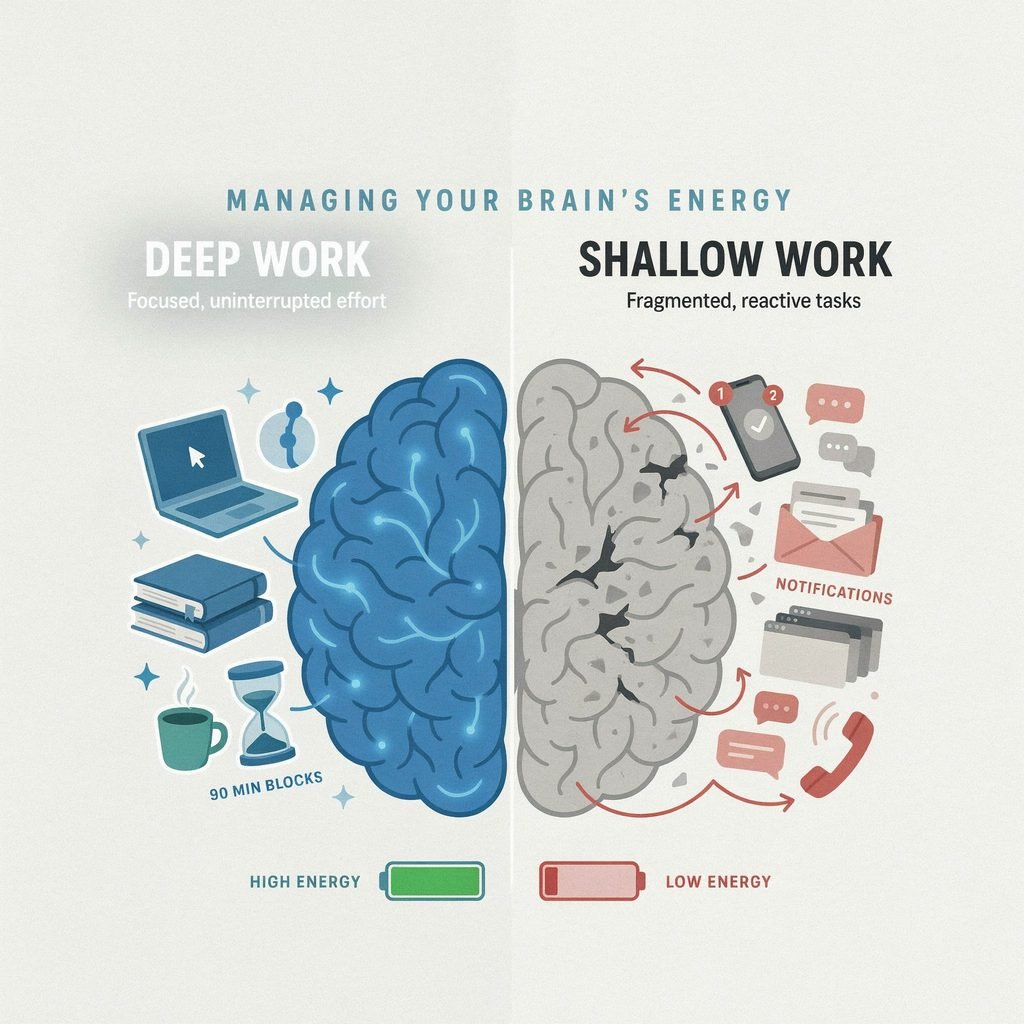
Here’s where the neuroscience of focus gets practical. Your brain isn’t a bottomless well of willpower. It runs on limited metabolic resources, and how you spend them determines whether you end the day energized or depleted.
Attention is a finite resource. Your prefrontal cortex—the region responsible for sustained attention, planning, and complex reasoning—fatigues with prolonged use. Every notification, every “quick question,” every app switch pulls resources away from the task at hand. Researchers call the leftover cognitive drag attention residue: part of your brain is still processing the last interruption even after you’ve returned to your work. Multiply that by 30 or 40 interruptions a day, and your mental bandwidth is effectively gutted.
Decision fatigue compounds quietly. Each small shallow task—reply or defer? Attend or decline? Which Slack channel first?—requires a micro-decision. Individually trivial. Collectively, they erode the same decision-making fuel you need for high-stakes, cognitively demanding tasks later in the day.
Your brain works in cycles. Research on ultradian rhythms suggests the brain can sustain peak focus for roughly 90 minutes before it needs a genuine recovery break. Push past that window without rest, and cognitive fatigue sets in: comprehension drops, errors rise, and you start reaching for your phone without realizing it.
Context switching is expensive. Studies from the University of California, Irvine, found it takes an average of 23 minutes to fully re-engage with a complex task after an interruption. If you’re pinged every 10 minutes, you never actually reach deep focus. You’re perpetually in warm-up mode.
Think of it this way: your brain is like a phone battery, and shallow work is like leaving 15 apps running in the background. Each one sips a little power. None feels significant. But by 2 p.m., you’re at 12% and wondering why you can’t focus on the one thing that actually matters.
Deep Work vs. Shallow Work: Key Differences
Let’s lay out the contrast clearly so you can audit your own schedule:
| Dimension | Deep Work | Shallow Work |
|---|---|---|
| Cognitive demand | High – full prefrontal engagement | Low – routine, repetitive |
| Value creation | High – advances key goals | Low to medium – maintains operations |
| Replicability | Hard – requires your specific skill | Easy – most anyone could do it |
| Best timing | Peak energy windows (often morning) | Lower-energy slots (post-lunch, late afternoon) |
| Emotional payoff | Fulfilling, energizing in hindsight | Draining, often anxiety-inducing |
| Distraction tolerance | Near zero | Moderate |
Understanding these deep work benefits and shallow work drawbacks helps you make a simple scheduling decision: protect your best hours for high-leverage activities, and contain the rest. That shift alone transforms productive work habits from wishful thinking into daily reality.
How to Structure Your Day Around Brain Energy
Knowing the theory is one thing. Restructuring a real Tuesday with standups, client calls, and a shared Slack workspace is another. Here’s a practical framework tailored to a typical US remote or hybrid schedule.
1. Identify your peak energy window.
For most people, sustained attention peaks between 8:00 and 11:30 a.m., though some are afternoon-focused. Experiment for one week: note when you feel sharpest, when you naturally reach for distractions, and when complex thinking feels effortless. That’s your deep work slot. Guard it fiercely.
2. Time-block 60–90 minutes of deep work.
Put it on your calendar like a meeting—with yourself. During this block, close email, silence Slack, and set your phone to Do Not Disturb. One clear objective. One output. No exceptions.
3. Batch shallow tasks into designated windows.
Instead of answering emails all day, create two “shallow work hours”—say, 11:30–12:00 and 4:00–4:30. Process emails, respond to messages, handle admin, and update trackers in those windows. Outside them, you’re unreachable for non-urgent pings. This is batching shallow tasks in action, and it eliminates the all-day reactivity that fragments your focus.
4. Protect the block socially.
Communicate your boundaries. A simple Slack status—”In focus mode until 11:00, will respond after”—sets expectations without burning bridges. For managers: model this behavior. If you ping your team at all hours, no one will ever do deep work.
Example: A marketing manager in Chicago.
Sarah leads a five-person content team at a mid-size SaaS company. Her old schedule was a blur of Slack, standups, and “quick reviews.” She restructured:
- 8:30–10:00 a.m.: Deep work – strategy docs, campaign planning (phone in another room, Slack closed)
- 10:00–10:15: Break – coffee, short walk
- 10:15–11:30: Team standup + collaborative meeting
- 11:30–12:00: Shallow batch – emails, Slack catch-up, approvals
- 12:00–1:00: Lunch, away from screens
- 1:00–2:30: Collaborative work – reviews, feedback sessions
- 2:30–3:00: Shallow batch – reports, scheduling, admin
- 3:00–4:30: Second focus block or collaborative project work
Within two weeks, she shipped a quarterly campaign strategy that had been “in progress” for a month. The work didn’t get harder. The structure did.
Practical Tactics to Increase Deep Work
Ready to build a deep work routine? These focus rituals and environmental tweaks make starting easier and sticking with it more automatic.
Design your environment:
- Use a dedicated workspace—even if it’s just a specific chair and desk angle that signals “focus mode” to your brain
- Noise-canceling headphones or a white-noise app to buffer open-office or household sounds
- Clear visual clutter; keep only the current project in sight
Create a 2-minute launch ritual:
- Close every browser tab unrelated to the task
- Write one sentence: “In this block, I will produce ___”
- Start a visible timer (90 minutes, 60 minutes—whatever fits)
- Put on the same playlist or ambient track each time to trigger a Pavlovian focus cue
Leverage productivity tools for focus:
- Website blockers (Cold Turkey, Freedom, or built-in Focus modes on Mac/Windows) during deep blocks
- A simple Pomodoro or countdown timer for structure
- Calendar tools with “busy” blocks so colleagues can’t book over your focus time
Set hard rules to limit shallow work:
- No email before your first deep work block
- Slack checked only at batched intervals (e.g., 11:30, 2:30, 4:30)
- “If it’s not urgent, it goes in tomorrow’s shallow window”
Build in recovery:
- After each deep block, take 10–15 minutes away from screens: a short walk, stretching, hydration, staring out a window
- Resist the urge to “reward” focus time with social media scrolling—that’s just more cognitive load
- Protect at least one full evening per week with zero work notifications
These eliminate distractions without requiring superhuman willpower. You’re engineering the path of least resistance toward focused concentration.
Common Mistakes & How to Avoid Them
Even well-intentioned professionals stumble when they start doing deep work. Watch for these deep work mistakes:
- Trying to force deep work inside a meeting-packed calendar without negotiating. If your day is wall-to-wall Zoom calls, no amount of willpower creates focus. Fix: talk to your manager. Propose two meeting-free mornings per week. Most US companies will accommodate if you frame it around output.
- Scheduling deep work during your personal energy crash. If 1:30 p.m. is your post-lunch fog, don’t put your hardest task there. Fix: shift deep blocks to your genuine peak and use the dip for admin.
- Calling distracted time “deep work.” If Slack is open, email is pinging, and your phone is face-up, you’re doing shallow work with extra guilt. Fix: full disconnection or it doesn’t count.
- Over-scheduling focus time and triggering productivity burnout. Three hours of genuine deep work is a strong day. Five hours daily is a recipe for over-scheduling focus time and frying your prefrontal cortex. Fix: cap deep work at 3–4 hours and set realistic deep work goals.
Conclusion: Protect Your Mental Energy, Not Just Your Time
Here’s the reframe that changes everything: your constraint isn’t time. You have the same eight hours as everyone else. Your constraint is brain energy—and deep work vs. shallow work determines where that energy goes.
Deep work creates value, builds your reputation, and gives your day meaning. Shallow work keeps the lights on. Both are necessary. But only one moves you forward.
So here’s your move. Tomorrow morning, before you open your inbox, before you check Slack, before anyone else gets a claim on your attention: protect one 60-minute deep work block. One task. One output. No interruptions.
Then, at the end of the week, audit your last three days. How many hours were truly deep? How many dissolved into reactive, fragmented busywork? The gap between those numbers is your opportunity.
If you want accountability, try a 7-day focus challenge: one protected deep work block every morning for a week. No negotiations, no exceptions. Notice what you produce. Notice how you feel at 5 p.m. when you’ve actually built something.
Your brain’s energy is your most valuable professional asset. Stop letting 47 unread notifications spend it for you. Protect it. Direct it. Do the work that matters.
What’s the single biggest distraction stealing your focus right now? Drop it in the comments—sometimes naming the problem is the first step to reclaiming your attention.