The alarm goes off at 6:30 AM, and before your feet even hit the floor, your mental to-do list is already screaming at you. You rush through the morning, tackle a barrage of emails, sit through back-to-back meetings, and somehow, by 8:00 PM, you’re collapsing onto the couch utterly exhausted. Yet, as you scroll mindlessly through your phone, a sinking feeling washes over you: you worked all day, but you didn’t actually move the needle on what matters most.
If this scenario sounds painfully familiar, you aren’t alone. Modern US “hustle culture” has sold us a toxic lie: that the secret to success is simply working harder, sleeping less, and packing every waking second with output. But this approach ignores the reality of digital overstimulation and the very human limits of our attention spans. Standard “just grind harder” advice doesn’t just fail; it actively accelerates burnout.
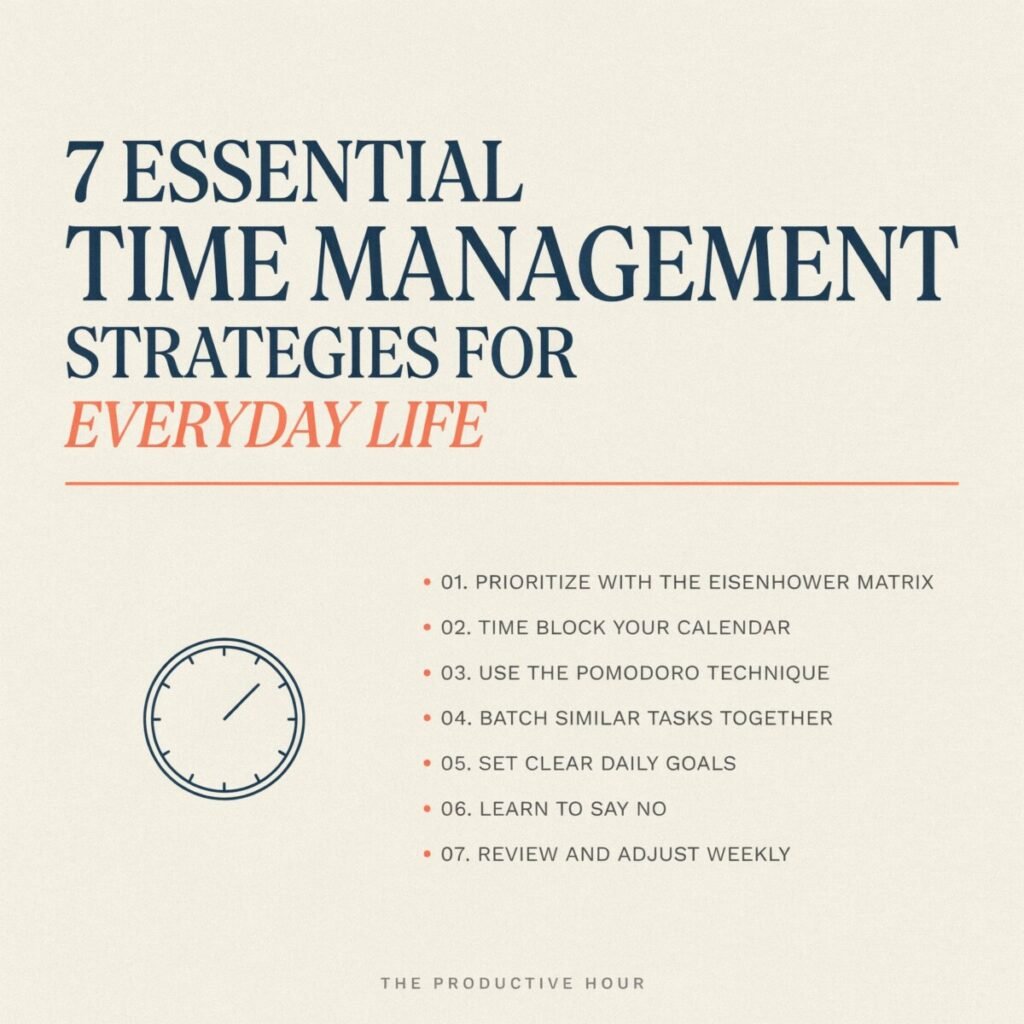
True mastery over your schedule isn’t about squeezing more tasks into your day. It’s about intentional living. It’s about reclaiming your mental space, protecting your energy, and making deliberate choices that align with your actual goals. By shifting your mindset from “time management” to “attention management,” you can achieve a sustainable work-life balance. Below are seven highly effective time management strategies designed to help you take back your day, reduce stress, and finally make progress on what truly counts.
Strategy 1: Conduct a 3-Day “Time Audit”
You cannot manage what you do not measure. Most of us operate under a massive illusion regarding how we spend our hours. We think we worked for eight hours, but in reality, we worked for four hours and spent the other four reacting to distractions. Before you can optimize your schedule, you need hard data on where your time is actually going.
Action Steps: The Judgment-Free Track
For three consecutive days, track your time in 30-minute increments. You don’t need complex software; a simple pocket notebook or a free app like Toggl Track works perfectly.
- Log everything: Include work tasks, commuting, scrolling on social media, cooking, and even staring blankly at the wall.
- Suspend judgment: The goal of a time audit is data collection, not self-shaming. Treat yourself like a subject in a fascinating scientific study.
Key Insight: Uncovering Hidden Leaks
When you review your audit, you will inevitably find “time leaks.” You might discover that you spend 45 minutes every morning context-switching between Slack and your inbox before actually starting your primary project.
Real-Life Scenario: Sarah, a marketing director, felt she was working 60-hour weeks. After a 3-day audit, she realized she was spending nearly two hours a day reading and replying to non-urgent internal newsletters and group chats. By simply unsubscribing and muting low-priority channels, she reclaimed 10 hours a week without dropping a single core responsibility.
Strategy 2: Prioritize with the Eisenhower Matrix
Not all tasks are created equal, yet our to-do lists treat them as if they are. We often confuse urgency (tasks demanding immediate attention) with importance (tasks that contribute to our long-term mission and values). Relying on a standard checklist usually results in putting out fires all day while neglecting goal setting and strategic growth.
Action Steps: The 4 Quadrants
Divide a piece of paper into four boxes and categorize your tasks using the Eisenhower Matrix, one of the most enduring prioritization techniques in existence:
- Do First (Urgent & Important): Crises, pressing deadlines, and critical problems. Handle these immediately.
- Schedule (Not Urgent & Important): Strategic planning, exercise, skill-building, and relationship building. Block time for these.
- Delegate (Urgent & Not Important): Interruptions, some emails, and minor administrative favors. Pass these to someone else or automate them.
- Delete (Not Urgent & Not Important): Doomscrolling, busywork, and time-wasting meetings. Eliminate these ruthlessly.
Key Insight: The Power of Quadrant 2
High-performers intentionally spend the majority of their time in Quadrant 2 (Important, but Not Urgent). By proactively scheduling time for maintenance, planning, and health, you prevent those tasks from eventually turning into Quadrant 1 emergencies.
Real-Life Scenario: A freelance graphic designer constantly stressed over tight client deadlines (Quadrant 1). By shifting her focus to Quadrant 2—spending two hours every Monday updating her portfolio and pitching new, higher-paying clients—she eventually replaced her most demanding, low-paying clients, drastically reducing her daily stress.
Strategy 3: Master the “Time Blocking” Method
A to-do list is essentially an infinite bucket of demands, which induces low-grade anxiety every time you look at it. A calendar, however, is a finite resource. Daily schedule optimization requires you to treat your time like a financial budget: every hour must be allocated a specific purpose before the day even begins. This is the core of the time blocking method.
Action Steps: Budget Your Hours
Open your digital calendar (Google Calendar, Outlook, or Apple Calendar) and assign specific blocks of time to your tasks.
- Deep Work Blocks: Schedule 90-minute windows for your most cognitively demanding tasks. Guard these fiercely.
- Admin Blocks: Group shallow work into specific, limited windows.
- Buffer Zones: Always schedule 15-to-30-minute buffers between meetings or major tasks. Traffic happens, meetings run late, and biological needs arise.
Key Insight: Psychological Freedom
Paradoxically, structuring every minute of your day creates immense psychological freedom. When you know exactly when you are going to tackle your emails or hit the gym, you stop worrying about them while you are doing other things. You are fully present in the current block.
Real-Life Scenario: Instead of keeping a running list of “things to write,” a content manager blocks out “Tuesday 9:00 AM – 11:00 AM: Draft Blog Post” and “Thursday 2:00 PM – 3:00 PM: Edit Newsletter.” When Tuesday at 9 AM arrives, there is no decision fatigue. She simply sits down and executes the block.
Strategy 4: Group Similar Work with “Task Batching”
Every time you switch from writing a complex report to answering a quick email, and then back to the report, your brain experiences “attention residue.” A portion of your cognitive processing remains stuck on the previous task. This constant context-switching drastically increases your cognitive load and drains your mental battery, leaving you exhausted by mid-afternoon.
Action Steps: Batch by Context
Task batching involves grouping similar, low-stakes tasks together and completing them in one dedicated swoop, rather than sprinkling them throughout your day.
- Communication Batching: Check and respond to emails only three times a day (e.g., 10:00 AM, 1:00 PM, and 4:30 PM). Turn off desktop notifications outside these windows.
- Errand Batching: Run all your physical errands (grocery store, post office, dry cleaners) in one single trip on Saturday morning.
- Admin Batching: Pay all your bills, update your budget, and file expenses in one 45-minute sitting on the first of the month.
Key Insight: Preserving Deep Focus
By containing your shallow work into tight batches, you preserve your peak cognitive energy for deep, meaningful work. You stop fracturing your attention and start operating with sustained momentum.
Real-Life Scenario: A small business owner used to stop her creative design work every time her phone buzzed with a customer inquiry. By implementing an auto-responder that said, “I check messages at 11 AM and 3 PM,” and batching her replies, she cut her daily work hours by 20% while actually improving her customer response time.
Strategy 5: Use Micro-Focus Sprints (The Pomodoro Technique)
We’ve all stared at a massive, intimidating project and felt the heavy, paralyzing weight of procrastination. When a task feels too big, the brain’s amygdala registers it as a threat, triggering an avoidance response. One of the most reliable productivity hacks for overcoming procrastination is to shrink the time horizon until the task feels entirely non-threatening.
Action Steps: The 25/5 Cycle
The Pomodoro Technique uses a simple timer to create a sense of urgency and focus.
- Pick one specific task. (e.g., “Outline the Q3 presentation,” not “Work on presentation”).
- Set a timer for 25 minutes. Commit to working only on that task until the timer rings. No phone, no tabs, no exceptions.
- Take a 5-minute break. Stand up, stretch, or grab water.
- Repeat. After four 25-minute sprints, take a longer 15-to-30-minute break. (Note: For deep writing or coding, many professionals prefer a modified 50-minute work / 10-minute break cycle).
Key Insight: Breaking Starter’s Block
The magic of the Pomodoro isn’t just the focus; it’s the friction reduction. Telling yourself, “I just have to work on this dreadful spreadsheet for 20 minutes,” is infinitely easier than saying, “I need to finish this spreadsheet today.” Once the timer starts, momentum usually takes over, and you’ll often choose to keep working past the 25-minute mark.
Real-Life Scenario: A graduate student struggling to write his thesis used the Pomodoro method to trick his brain. He told himself he only had to write for one 25-minute sprint. By lowering the barrier to entry, he bypassed his anxiety and ended up writing for two hours straight, finally breaking a month-long writer’s block.
Strategy 6: Set Clear Boundaries and Learn the “Art of the Polite No”
At its core, time management is actually boundary management. You can use all the apps and matrices in the world, but if you cannot say “no” to the demands of others, your schedule will always belong to them. Every time you say “yes” to a low-priority obligation, you are implicitly saying “no” to your own goals, your health, or your family time.
Action Steps: Scripts for the Polite No
Saying no doesn’t mean being rude or unhelpful. It means being clear and professional. Memorize a few of these go-to scripts for both your professional and personal life:
- The Capacity Check: “I’d love to help with this, but my plate is completely full this week. Can we revisit this next month?”
- The Deferral: “I’m heads-down on a critical project right now and can’t take on new commitments. Have you asked [Colleague’s Name]? They might have the bandwidth.”
- The Personal Boundary: “I’m making it a priority to disconnect and spend time with my family this weekend, so I won’t be checking Slack until Monday morning.”
Key Insight: Protecting Your Peace
Setting boundaries is a crucial pillar of burnout prevention. People generally respect those who respect their own time. When you communicate your boundaries clearly and consistently, you train your colleagues, friends, and family on how to treat you and what to expect from you.
Real-Life Scenario: A mid-level manager was constantly pulled into “quick sync” meetings that derailed her afternoons. She updated her calendar to show “Focus Time” from 1 PM to 3 PM and politely declined invites during that window, offering a 15-minute slot the next morning instead. Her team quickly adapted, and her overall output skyrocketed.
Strategy 7: Design an “End-of-Day Shutdown Routine”
In the era of remote work and smartphones in our pockets, the physical boundary between the office and the living room has vanished. Without a deliberate transition, work-related stress bleeds into your evening, ruining your downtime and disrupting your sleep. The Zeigarnik effect—a psychological principle stating that people remember uncompleted or interrupted tasks better than completed ones—means your brain will keep looping over unfinished work unless you give it a clear “all clear” signal.
Action Steps: The 10-Minute Ritual
Create a hard stop at the end of your workday. Spend the last 10 to 15 minutes executing a shutdown ritual:
- Review your calendar: Look at tomorrow’s schedule so there are no surprises waiting for you in the morning.
- Clear your digital and physical workspace: Close your browser tabs, organize your desktop, and tidy your physical desk.
- Identify your Top 3: Write down the three most important priorities for tomorrow.
- Say the magic words: Literally say a shutdown phrase out loud, like “Shutdown complete” or “I am done for the day.”
Key Insight: Reclaiming Your Evenings
This ritual signals to your nervous system that it is safe to power down. It transfers the burden of remembering what to do next from your working memory onto a piece of paper, drastically reducing late-night anxiety and allowing you to fully engage in your personal life.
Real-Life Scenario: A work-from-home dad found himself checking emails at 9:00 PM while watching TV with his kids, feeling guilty and stressed. By implementing a strict 5:30 PM shutdown routine—closing his laptop, putting it in a drawer, and taking a 15-minute walk around the block—he created a psychological “commute” that allowed him to be fully present with his family all evening.
Conclusion: Start Small, Build Momentum
Feeling overwhelmed by your schedule is a natural response to the demands of modern life, but it doesn’t have to be your permanent reality. The time management strategies outlined above are not about turning you into a hyper-efficient robot; they are tools to help you reclaim your humanity, protect your energy, and make space for intentional living.
However, the biggest mistake you can make is trying to implement all seven of these strategies at once. That is a guaranteed recipe for failure. Instead, pick just one strategy to focus on this week. Maybe you start with a 3-day time audit, or perhaps you finally try the Pomodoro Technique to tackle that daunting project. Master one habit, and then layer on the next.
Which of these strategies are you going to try tomorrow morning to take back your day? Let us know in the comments below, and here’s to a more focused, balanced, and fulfilling week ahead!