The “Busy-Brag” Epidemic: Are You Moving or Progressing?
If I ask ten American professionals how they are doing this week, at least seven will give me the exact same exhausted response: “I’m just so crazy busy right now.”
In the modern US workplace, busyness has become a bizarre status symbol. We wear our packed calendars and back-to-back Zoom fatigue like badges of honor. We engage in “busy-bragging” at the virtual watercooler, subtly implying that our overwhelming workload equates to our professional value.
But here is the uncomfortable truth: busyness is a distraction from actual impact.
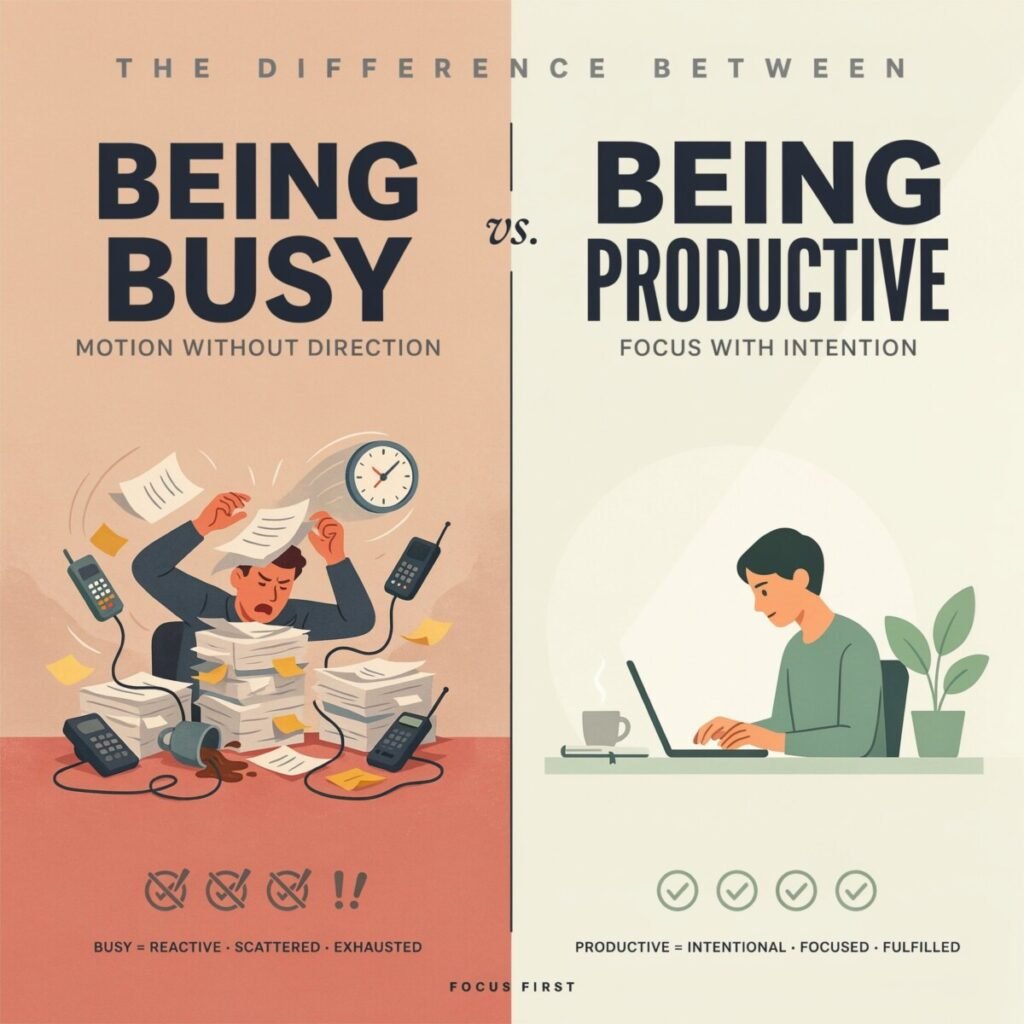
Understanding the difference between being busy and productive is the single most important mindset shift you can make in your career. Busyness is about movement, chaos, and endless input. Productivity is about progress, clarity, and meaningful output.
If you are tired of ending every Friday afternoon completely drained, yet feeling like you accomplished nothing of real substance, you are not alone. It is time to deconstruct the hustle culture trap and learn how to reclaim your time, your focus, and your sanity.
The Mindset Gap: Motion vs. Action
To truly master intentional productivity, we first have to redefine what it means to work. We must understand the critical distinction between motion vs action.
Being busy is almost entirely characterized by motion. Motion is planning, researching, strategizing, and organizing. It is color-coding your calendar, tweaking the font on a slide deck, or scrolling through LinkedIn for “industry inspiration.” Motion feels like work, but it produces no tangible result.
Being productive, on the other hand, is characterized by action. Action is the behavior that delivers a concrete outcome. It is actually writing the proposal, publishing the code, or making the sales call.
When we are trapped in the busyness cycle, we default to shallow work. This consists of non-cognitively demanding, logistical tasks performed while distracted. Think of rapidly firing off Slack replies, sitting in status-update meetings, and aggressively chasing the mythical “inbox zero.” Shallow work keeps the lights on, but it rarely moves the needle.
True productivity requires protecting your time for deep work vs shallow work. Deep work is the ability to focus without distraction on a cognitively demanding task. It is the state of flow where high-value, career-defining output is generated.
A busy professional lets shallow work dictate their day, allowing their inbox to act as a to-do list. A productive professional aggressively guards their deep work time, knowing that their most significant contributions require uninterrupted, focused action.
The Psychology Behind the “Busyness Trap”
If being productive is so much better for our careers and our mental health, why do we constantly default to being busy? The answer lies in our brain’s neurochemistry and the modern digital environment.
First, clearing minor tasks provides a quick, reliable hit of dopamine. When you check off five small emails, your brain rewards you with a chemical feeling of accomplishment. Conversely, tackling a massive, complex project involves high friction and delayed gratification. To avoid this friction, we engage in active procrastination. We fill our day with easy, low-impact tasks to create the illusion of progress while subconsciously avoiding the hard, meaningful work.
Second, we are victims of Parkinson’s Law, which states that “work expands so as to fill the time available for its completion.” If you give yourself four hours to write a brief report, your brain will subconsciously stretch the task to take four hours. You will over-research, over-edit, and allow interruptions, turning a simple task into a busy-work marathon.
Finally, we cannot ignore the intense psychological pressure of digital presenteeism. In remote and hybrid environments, there is a pervasive fear of looking inactive. We feel compelled to maintain a “green status” indicator on Slack or Microsoft Teams.
This anxiety drives cognitive load & context switching. We keep our notification badges turned on, instantly pivoting from deep strategic thinking to answer a coworker’s trivial question. Every time you switch contexts, it takes your brain an average of 23 minutes to regain deep focus. By trying to look busy and responsive, you are actively destroying your ability to be productive.
Side-by-Side Comparison: Busy vs. Productive
To help you diagnose your own daily habits, let’s look at a direct comparison. The core philosophy here is a shift from output over input. Busyness measures input (hours logged, emails sent). Productivity measures output (value created, problems solved).
| Dimension | Being Busy (The Hamster Wheel) | Being Productive (The Compass) |
|---|---|---|
| Focus | Task volume; trying to clear the to-do list. | Impact quality; executing high-leverage tasks. |
| Communication | Instant replies; always available on Slack/Teams. | Asynchronous & intentional; batching communications. |
| Priorities | Saying “yes” to every request and meeting invite. | Strategic “no”; fiercely protecting core objectives. |
| Energy Management | Exhausted, scattered, and running on cortisol. | Focused, energized, and taking deliberate breaks. |
| End-of-Day Result | Tired with no real progress; “Where did the day go?” | Clear accomplishments; a sense of meaningful closure. |
As you review this table, be honest with yourself. Are you managing your time, or are you simply letting your calendar manage you?
Actionable Frameworks to Shift from Busy to Productive
Breaking the cycle of chronic busyness requires more than just willpower; it requires robust systems. Here are three proven time management strategies to help you transition from reactive motion to proactive action.
Framework 1: The Pareto Principle (80/20 Rule)
The Pareto Principle (80/20 rule) states that 80% of your results come from just 20% of your efforts. In the corporate world, this means that a tiny fraction of your daily tasks actually drive your performance reviews, revenue, and career growth.
How to apply it:
- Audit your week: Look at your last five days of work. Highlight the tasks that directly contributed to your core KPIs or major project milestones.
- Identify the 20%: You will likely find that drafting strategic proposals, analyzing key data, or closing high-value deals made up only a few hours of your week, yet drove the most impact.
- Eliminate or Delegate the 80%: Ruthlessly automate, delegate, or simply stop doing the low-impact busy work that eats up your remaining hours. Stop formatting internal memos to perfection when a quick bulleted list will do.
Framework 2: The Eisenhower Matrix
President Dwight D. Eisenhower famously organized his obligations by urgency and importance. The Eisenhower Matrix is the ultimate tool for eliminating “fake urgency”—the illusion that every ping, ring, and notification requires your immediate attention.
How to apply it:
- Quadrant 1 (Urgent & Important): Crises and deadlines. Do these immediately. (e.g., A server crash, a major client escalation).
- Quadrant 2 (Not Urgent & Important): Strategic planning, skill-building, relationship building. Schedule these. This is where deep work lives. Busy people ignore Quadrant 2 until it becomes a Quadrant 1 crisis.
- Quadrant 3 (Urgent & Not Important): Most emails, unnecessary meetings, minor favors. Delegate these. This is the trap of active procrastination.
- Quadrant 4 (Not Urgent & Not Important): Doomscrolling, tweaking fonts, office gossip. Delete these entirely.
Framework 3: Time Blocking & Batching
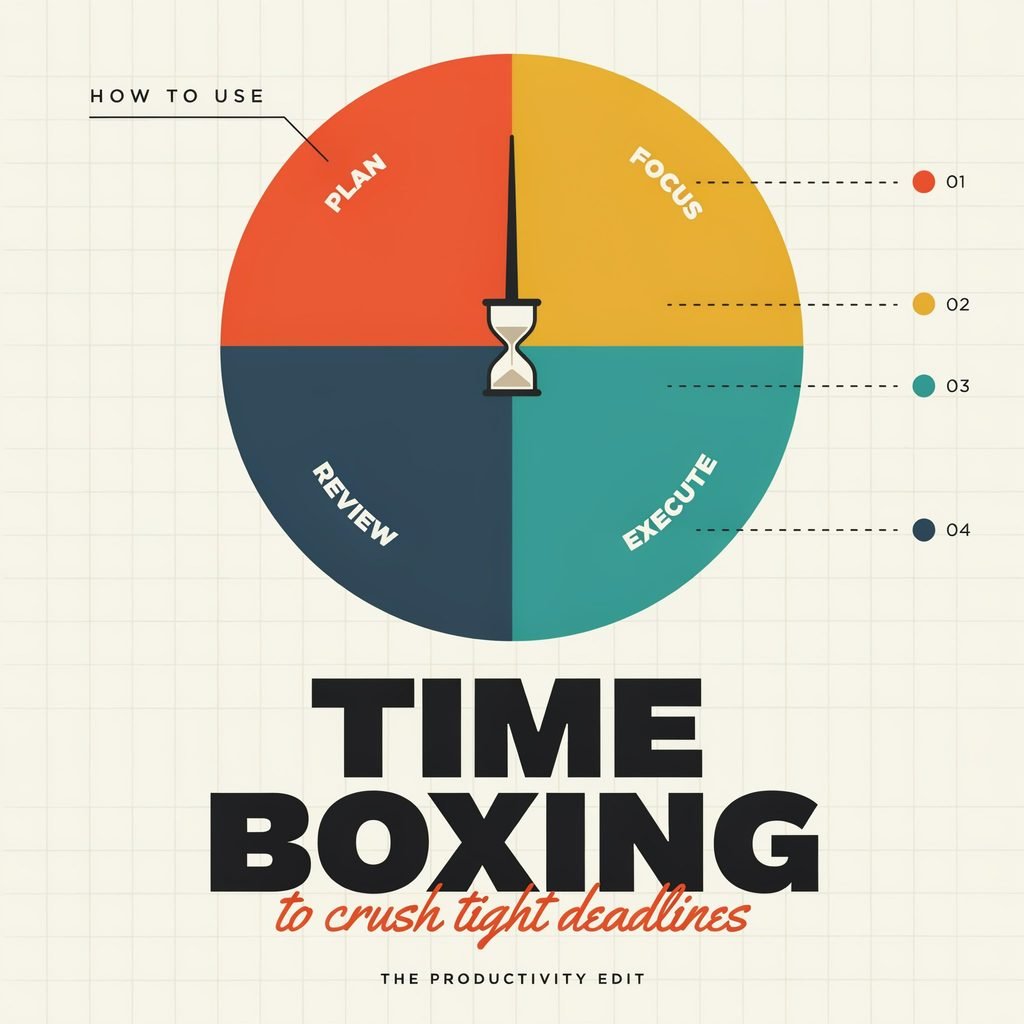
If your calendar looks like a game of Tetris with 15 different 30-minute meetings scattered throughout the day, you are setting yourself up for failure. Time blocking involves dedicating specific chunks of time to a single task or category of tasks, drastically reducing the tax of context switching.
How to apply it:
- Create “Maker” and “Manager” schedules: Block out 9:00 AM to 11:30 AM strictly for deep, uninterrupted project work. Turn off Slack and put your phone in another room.
- Batch your shallow work: Instead of checking email every 5 minutes, schedule two 30-minute blocks (e.g., 11:30 AM and 4:00 PM) to process your inbox all at once.
- Defend your blocks: Treat your time blocks as immovable meetings with yourself. If a colleague asks for a quick chat during a deep work block, reply asynchronously: “I’m heads-down on a project right now, but I will review this during my 4 PM email block!”
Cultivating Sustainable Productivity & Avoiding Burnout
The relentless pursuit of “busyness” is not just bad for your output; it is actively destroying your health. Chronic busyness keeps your nervous system in a constant state of fight-or-flight. Over time, this elevated cortisol leads directly to workplace burnout prevention failures, chronic fatigue, sleep disruption, and the growing phenomenon of “quiet quitting.”
Hustle culture sells the lie that you must sacrifice your well-being to achieve professional success. But in reality, sustainable success requires treating your energy as a finite, highly valuable resource.
Workplace burnout prevention starts with setting firm, non-negotiable boundaries. It means logging off at 5:30 PM without guilt. It means taking a full, screen-free lunch break away from your desk to allow your brain’s default mode network to process information and generate creative insights.
When you prioritize energy management over time management, you stop viewing rest as a reward for working hard, and start viewing it as a prerequisite for working well. A well-rested professional who works 35 focused hours a week will consistently out-produce an exhausted, burned-out worker who grinds for 60 hours.
Conclusion & Your 5-Minute Takeaway
Ultimately, the difference between being busy and productive boils down to intention. Busyness is a reactive state where you allow external demands to dictate your day. Productivity is a proactive choice where you dictate your impact.
By shifting your focus from input (the sheer volume of hours you sit at your desk) to output (the actual value you create), you can escape the hamster wheel. You can stop participating in the busy-brag and start doing work that actually matters.
Your 5-Minute Takeaway for Today:
Open your calendar for tomorrow right now. Spend exactly five minutes auditing your schedule. Find at least one low-value meeting, recurring sync, or “optional” catch-up that does not align with your core priorities. Decline it, or ask for a 5-minute asynchronous written update instead. Reclaim that 30-to-60-minute block, label it “Deep Work,” and protect it fiercely.
Stop moving. Start progressing.