In the modern United States, the pace of life often feels like a relentless sprint. Between demanding careers, family responsibilities, side hustles, and the constant ping of digital notifications, finding enough hours in the day can seem impossible. Whether you are a college student juggling finals, a corporate professional navigating endless Zoom meetings, an entrepreneur building a business from the ground up, or a remote worker trying to separate the office from the living room, the struggle is universal. We all have the same 24 hours, yet some people seem to accomplish significantly more while still maintaining a healthy work-life balance. What is their secret? The answer lies not in working harder, but in working smarter.
Mastering how to manage time effectively is one of the most valuable skills you can develop. It is the foundation of personal productivity and the key to achieving your long-term ambitions without burning out. However, true efficiency is not about cramming as many tasks as possible into your schedule; it is about intentionality. It is about ensuring that the hours you spend align with your most important goals.
If you are tired of ending each day feeling exhausted yet unaccomplished, it is time to rethink your approach. By adopting a few foundational time management rules, you can transform your daily routine, reduce stress, and reclaim your focus. In this comprehensive guide, we will explore the golden rules of time management, common pitfalls to avoid, and practical productivity strategies tailored to your specific lifestyle. Let’s dive in and discover how to take back control of your schedule.
What Time Management Really Means
Before we dive into the specific strategies, it is crucial to understand what time management actually entails. Many people mistakenly believe that time management is simply about creating a massive to-do list and checking off boxes as fast as possible. While staying organized is important, true time management is much deeper.
At its core, time management is the conscious process of planning and exercising control over the amount of time spent on specific activities. It is about effectiveness, not just efficiency. Efficiency is doing things right; effectiveness is doing the right things. Good time management rules help you identify what truly matters and allocate your energy accordingly.
Furthermore, modern time management is deeply intertwined with energy management and attention management. You might have three free hours in the afternoon, but if your mental energy is depleted, your focus and concentration will suffer, rendering those hours largely unproductive. Therefore, effective planning involves understanding your natural energy rhythms, scheduling demanding tasks when you are most alert, and building productivity habits that sustain your momentum throughout the day. Ultimately, learning how to manage time effectively means designing a life where your daily actions reflect your highest priorities, allowing you to achieve professional success while preserving your personal well-being.
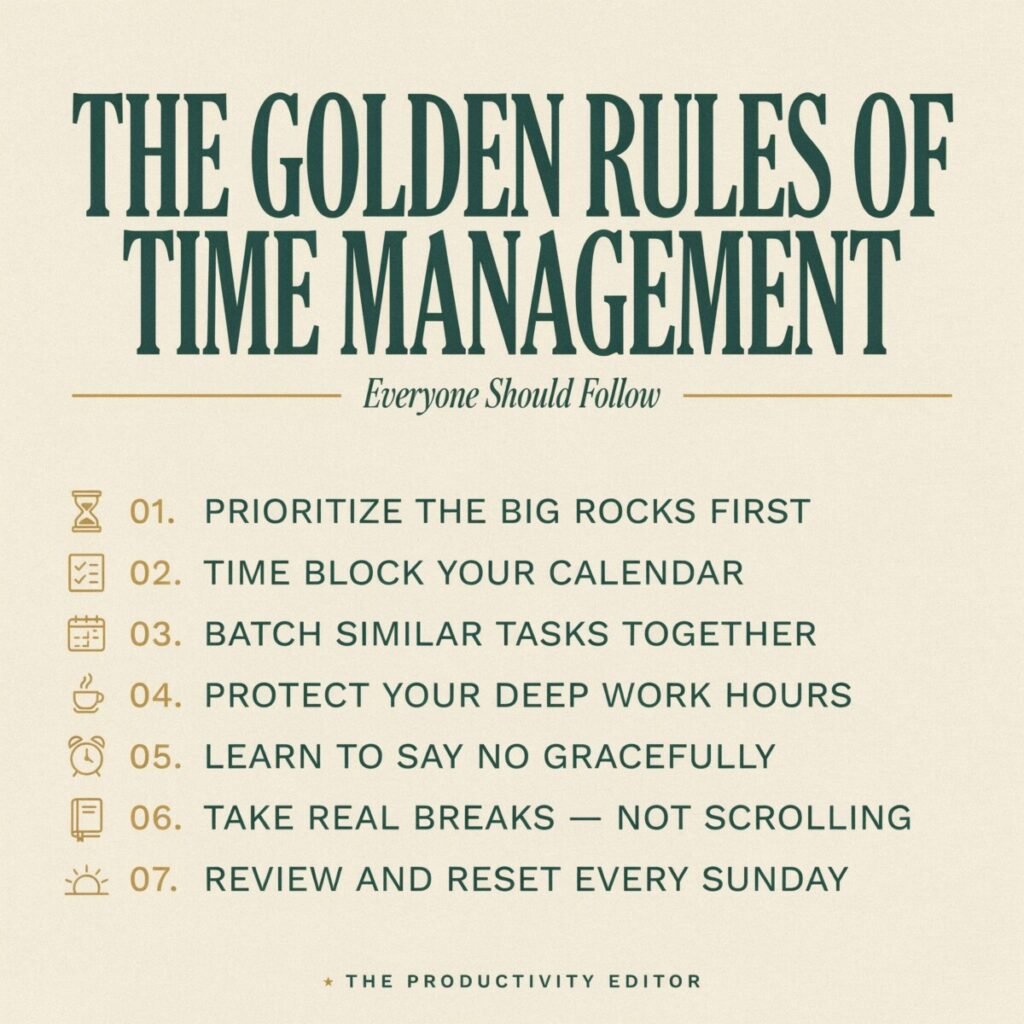
The Golden Rules of Time Management
To build a highly productive and balanced life, you need a reliable framework. The following time management rules are universally applicable and have been proven to help individuals across various industries maximize their output while minimizing stress.
1. Set Clear Priorities
Not all tasks are created equal. One of the most critical time management rules is learning how to prioritize tasks effectively. If you treat every item on your to-do list as equally urgent, you will inevitably waste time on low-value activities. To master task prioritization, consider using the Eisenhower Matrix, which categorizes tasks into four quadrants based on urgency and importance. Focus your energy on tasks that are important but not necessarily urgent—these are often the strategic, long-term goal-setting activities that drive real progress. By identifying your top three non-negotiable tasks each day, you ensure that your efforts are directed toward high-impact outcomes, significantly boosting your workplace productivity and personal success.
2. Plan Your Day in Advance
Waking up without a plan is a recipe for reactivity. When you don’t dictate your schedule, the world will dictate it for you through unexpected emails, urgent requests, and distractions. Daily planning is a cornerstone of better time management. Take 10 to 15 minutes each evening to map out the following day. Review your calendar, identify your top priorities, and allocate specific time slots for deep work. This simple act of effective planning reduces decision fatigue in the morning. When you sit down at your desk, you already know exactly what needs to be done, allowing you to bypass the procrastination trap and dive straight into meaningful work.
3. Focus on One Task at a Time
In our hyper-connected culture, multitasking is often wrongly glorified as a badge of honor. However, cognitive science tells us that the human brain cannot truly focus on multiple complex tasks simultaneously. Instead, it rapidly switches between them, which drains mental energy and increases the likelihood of errors. To improve your focus and concentration, commit to single-tasking. Give your undivided attention to the project in front of you until it is complete or until your designated time block is over. You will find that you finish tasks much faster and with higher quality when you eliminate the cognitive switching costs associated with multitasking.
4. Use Time Blocking
Time blocking is one of the most powerful productivity strategies available. Instead of working from an open-ended to-do list, divide your day into distinct blocks of time, each dedicated to a specific task or category of work. For example, you might block out 9:00 AM to 11:00 AM for deep strategic work, 11:00 AM to 11:30 AM for checking emails, and 1:00 PM to 2:00 PM for meetings. This approach to schedule management creates a psychological commitment to the task at hand and prevents minor tasks from expanding to fill your entire day. Time blocking also makes it easier to estimate how long tasks actually take, improving your future planning accuracy.
5. Eliminate Distractions
You cannot manage your time if you are constantly interrupted. Managing distractions is essential for maintaining deep work states. Identify your primary time-wasters—is it social media, chatty coworkers, non-urgent email notifications, or a cluttered workspace? Once identified, take proactive steps to mitigate them. Turn off non-essential push notifications on your phone, use website blockers during focus hours, and communicate your “do not disturb” boundaries to your colleagues or family members. Creating a physical and digital environment that supports your focus is a fundamental rule for anyone seeking personal productivity.
6. Break Big Goals into Smaller Tasks
Massive projects can feel overwhelming, which is a primary trigger for procrastination. When faced with a daunting objective, our brains often trigger an avoidance response. To avoid procrastination and maintain momentum, practice the art of chunking. Break your large, long-term goals down into small, actionable, and highly specific steps. Instead of writing “Finish quarterly report” on your list, break it down into “Gather Q3 sales data,” “Draft executive summary,” and “Create visual charts.” Completing these micro-tasks provides a steady stream of dopamine, keeping you motivated and making deadline management feel much more achievable.
7. Learn to Say No
Every time you say “yes” to a minor request, you are implicitly saying “no” to your own priorities. Overcommitting is a fast track to burnout and poor schedule management. Learning to say no gracefully but firmly is a vital time management rule, especially for ambitious professionals and freelancers. Protect your time fiercely. If a new request does not align with your current goals, or if you simply do not have the bandwidth, politely decline or negotiate a later deadline. Preserving your time for high-value activities is essential for maintaining a healthy work-life balance and ensuring you have the capacity to deliver excellent work on your most important projects.
8. Review Your Progress Regularly
Productivity is not a set-it-and-forget-it endeavor. To ensure your time management rules are actually working, you must build in time for regular reviews. Conduct a brief daily review at the end of your workday to assess what you accomplished and what needs to be moved to tomorrow. Additionally, schedule a weekly review on Friday afternoon or Sunday evening. Look at your broader goal setting metrics, evaluate your productivity habits, and adjust your schedule for the upcoming week. This continuous feedback loop allows you to identify bottlenecks, celebrate your wins, and refine your approach to better time management.
9. Protect Time for Rest and Recovery
Perhaps the most overlooked time management rule is the necessity of rest. You are not a machine; you are a human being who requires downtime to recharge. Chronic overworking leads to diminishing returns, decreased focus and concentration, and eventual burnout. Intentionally schedule time for relaxation, hobbies, exercise, and spending time with loved ones. Treat these personal appointments with the same respect you would give to a meeting with your CEO. Adequate rest enhances cognitive function, boosts creativity, and ensures that when you are working, you are operating at your absolute peak.
Common Time Management Mistakes
Even with the best intentions, it is easy to fall into counterproductive habits. Recognizing these common time management mistakes is the first step toward correcting them.
Procrastination and the “Planning Fallacy”
Many people delay starting difficult tasks, waiting for the “perfect moment” or a burst of motivation that rarely comes. Coupled with this is the planning fallacy—the cognitive bias where we consistently underestimate how long a task will take. This leads to rushed work, missed deadlines, and immense stress. Combat this by using the “Two-Minute Rule” (if it takes less than two minutes, do it now) and always adding a 20% time buffer to your project estimates.
Overcommitting and People-Pleasing
The desire to be helpful or to seize every opportunity often leads to a packed schedule with zero margin for error. When you overcommit, the quality of your work suffers, and your stress levels skyrocket. Remember that your time is a finite resource. Saying yes to everything means you are not prioritizing tasks that truly move the needle in your career or personal life.
Constant Connectivity and Digital Distractions
The modern smartphone is a massive drain on workplace productivity. Checking your email every time a notification pings or mindlessly scrolling through social media fragments your attention span. It takes an average of 23 minutes to regain deep focus after an interruption. Failing to manage these digital distractions ensures that you will spend your entire day in a state of shallow work, never reaching the deep, meaningful productivity that drives real results.
Time Management Tips for Different Lifestyles
While the core time management rules remain the same, their application varies depending on your daily environment and responsibilities. Here is how to manage time effectively across different lifestyles.
For Students
College and university life requires balancing rigorous academic demands with social activities and often part-time jobs. Students should rely heavily on time blocking to dedicate specific hours to attending lectures, studying, and completing assignments. Use a digital or physical planner to track syllabus deadlines at the start of the semester. To avoid procrastination, break massive research papers into weekly milestones. Furthermore, utilize the Pomodoro Technique (25 minutes of intense focus followed by a 5-minute break) to maintain high focus and concentration during long study sessions without burning out.
For Office Workers
Corporate environments are notoriously fraught with meeting overload and constant email chatter. Office workers must master the art of defensive calendar management. Block out “focus time” on your shared calendar so colleagues cannot book you for unnecessary meetings. Batch process your emails—check them only at designated times (e.g., 9 AM, 12 PM, and 4 PM) rather than keeping your inbox open all day. When attending meetings, always demand a clear agenda beforehand and keep them as short as possible to protect your workplace productivity.
For Freelancers
Freelancers wear many hats: they are the CEO, the marketing department, the accountant, and the primary service provider. Because there is no boss looking over their shoulder, self-discipline is paramount. Freelancers should separate their client work from their administrative tasks by dedicating specific days or half-days to business management (invoicing, pitching, marketing). Strict schedule management is also crucial to prevent “scope creep” with clients. Clearly define working hours and communicate them to clients to maintain a healthy work-life balance and prevent burnout.
For Business Owners and Entrepreneurs
Entrepreneurs often struggle with delegating, feeling that they must do everything themselves to ensure it is done right. However, to scale a business, owners must focus on high-leverage activities—strategy, fundraising, and key partnerships. Use the Eisenhower Matrix to ruthlessly prioritize tasks. If a task is urgent but not highly strategic, delegate it or outsource it. Business owners must also prioritize effective planning by setting quarterly goals and reverse-engineering the daily actions required to achieve them, ensuring personal productivity aligns with the company’s overarching vision.
For Remote Workers
Working from home blurs the physical boundaries between the office and personal life, making it difficult to “clock out.” Remote workers must establish a dedicated workspace to signal to their brain that it is time to work. Create a strict morning routine that mimics a commute, and an end-of-day shutdown ritual to transition back into personal time. To combat isolation and manage distractions at home, communicate your schedule to family members or roommates, and consider using co-working spaces or coffee shops for a change of scenery when deep focus and concentration are required.
Tools That Can Help
Leveraging the right technology can drastically improve your schedule management and help you implement these time management rules seamlessly.
- Digital Calendars: Tools like Google Calendar, Outlook, or Apple Calendar are non-negotiable for daily planning and time blocking. Color-code your blocks to visually balance deep work, meetings, and personal time.
- Task Management Apps: Applications like Todoist, Asana, Trello, or Microsoft To Do allow you to capture tasks quickly, organize them by project, and prioritize tasks based on deadlines.
- Focus and Distraction Blockers: Apps like Freedom, Cold Turkey, or Forest can block distracting websites and apps across your devices during your designated deep work blocks, ensuring you stay on track.
- Time Trackers: Tools like Toggl or RescueTime help you audit where your time is actually going. This data is invaluable for your weekly reviews, highlighting hidden time-wasters and helping you adjust your productivity habits.
- Note-Taking and Organization: Platforms like Notion or Evernote serve as a “second brain,” allowing you to store research, project plans, and meeting notes in one centralized, staying organized hub, reducing the mental clutter of trying to remember everything.
Frequently Asked Questions (FAQ)
1. What is the single most important time management rule?
While all the rules are important, setting clear priorities is arguably the most critical. If you do not know what your most important tasks are, no amount of time blocking or speed will help you achieve meaningful results. Task prioritization ensures your energy is spent on high-impact activities.
2. How can I stop checking my phone constantly while working?
Start by turning off all non-essential push notifications. During your deep work blocks, place your phone in another room or use an app blocker. Out of sight, out of mind. Gradually increase your phone-free intervals to build your focus and concentration stamina.
3. Is it better to plan my day the night before or in the morning?
Most productivity experts recommend planning your day the night before. This allows your subconscious mind to process the plan while you sleep, and it prevents you from wasting your peak morning energy on deciding what to do. You can wake up and immediately execute your daily planning strategy.
4. How do I handle unexpected urgent tasks that ruin my schedule?
Unexpected crises will happen. The key is to build buffer time into your daily schedule—leave at least 20% of your day unscheduled. When an urgent task arises, assess its true importance. If it must be done immediately, drop your lowest-priority task for the day, not your highest.
Final Thoughts
Mastering the golden rules of time management is not about achieving perfection; it is about making consistent, intentional choices that align your daily actions with your long-term goals. Whether you are a student trying to ace your exams, an entrepreneur scaling a startup, or a remote worker seeking better work-life balance, the principles of effective planning, task prioritization, and managing distractions remain the same.
Remember that better time management is a skill that requires practice and patience. Start by implementing just one or two of these time management tips this week. As they become ingrained as natural productivity habits, gradually layer in more strategies. By taking control of your schedule, you are ultimately taking control of your life. Stop letting the clock dictate your day, and start using your time to build the future you truly desire.