Stepping Off the Treadmill
Do you ever feel like you are running on a treadmill? You put in maximum effort all day, yet you never seem to actually get anywhere.
This is the daily reality for millions of busy professionals, remote workers, and overwhelmed parents across the US. We are constantly juggling endless notifications, household chores, and side hustles, leaving us drowning in cognitive overload.
Traditional “hustle culture” tells us to just wake up at 4:00 AM, drink a green juice, and work harder. But that toxic advice completely fails when you are already running on empty and facing burnout.
True productivity isn’t about doing more things until you collapse. It is about doing the right things with calm, deliberate intention.
If you are chronically behind and constantly stressed, it is time to hit the reset button. Learning time management basics is the absolute first step to reclaiming your sanity and your weekends.
In this comprehensive guide, we will explore exactly how to organize your life without adding more stress to your already heavy plate.
We will strip away the chaos and organize life from scratch. By the end of this article, you will have a simple, five-step framework to rebuild your schedule this week.
Let’s take a deep breath, forgive ourselves for yesterday’s uncompleted to-do list, and get started.
Step 1: The Time Audit – Diagnosing Where Your Hours Actually Go
You cannot manage what you do not measure. Before building new productivity systems, you need to know where your time is currently disappearing.
This is where a comprehensive time audit comes into play. It is a simple, eye-opening exercise that reveals the hidden gaps in your day.
For the next three days, track everything you do in 30-minute increments. Be brutally honest with yourself during this process.
Note when you are actively working, when you are mindlessly scrolling on your phone, and when you are staring blankly at a screen in a brain fog.
You are specifically looking for “time leaks.” These are the subtle, insidious habits that drain your hours without providing any real value or joy.
Common time leaks include doomscrolling on social media, excessive context switching between browser tabs, and saying “yes” to favors way too quickly.
Callout Box: Identifying Your Time Leaks
| Time Leak | The Hidden Cost | Quick Fix |
|---|---|---|
| Doomscrolling | Loses 1-2 hours daily | Use app timers or grayscale mode |
| Context Switching | Destroys deep focus | Close unused browser tabs |
| People-Pleasing | Steals time from goals | Say “Let me check my schedule” |
Once you see the raw data, the illusion of “I just don’t have enough time” shatters completely. You actually do have the time; it is just misallocated.
Maybe you spend two hours a night watching Netflix, but claim you have no time to meal prep for the week. The audit brings radical clarity.
This baseline data gives you the exact insights needed to build a realistic, personalized daily routine blueprint that actually fits your lifestyle.
Step 2: Mind Uncluttering & The Master Dump
Your brain is a beautiful organ designed for generating brilliant ideas, not for holding them like a mental storage unit.
When you try to remember every single errand, urgent email, and upcoming deadline, you invite chronic anxiety into your life.
To regain control, you must aggressively release your mental bandwidth. This core concept is a foundational pillar of the famous Getting Things Done (GTD) method.
The strategy is incredibly simple: execute a “Master Brain Dump.” Get every single task, lingering worry, and random idea out of your head and onto paper.
Grab a blank analog notebook or open a trusted digital tool like Notion, Evernote, or Todoist. Write down absolutely everything that is on your mind.
Include the massive things, like “finish the Q3 financial report,” and the tiny things, like “buy more dog food” or “email Mom back.”
Do not organize or prioritize anything yet. Just let the thoughts flow freely until your mind finally feels quiet and spacious.
Once everything is safely captured, you can finally breathe. Now, it is time to categorize this massive, intimidating list into manageable buckets.
First, identify the immediate actionables. These are physical tasks that require your direct effort today or tomorrow to move forward.
Next, separate your ongoing commitments. These are recurring responsibilities like paying the mortgage, driving the kids to soccer practice, or attending weekly team syncs.
Finally, filter out the non-essential noise. These are the “someday/maybe” ideas that are currently just cluttering your mental space and causing unnecessary guilt.
By externalizing your tasks, you instantly reduce stress. You have successfully moved from a state of chaotic panic to a state of calm preparedness.
Step 3: Prioritization Frameworks for Beginners
Now that you have a comprehensive master list, you cannot just tackle items at random. Effective priority setting is the ultimate secret to avoiding burnout.
Without a proven system, human nature dictates that we gravitate toward easy, urgent tasks while completely ignoring the important, long-term goals.
Let’s fix that behavioral trap with two highly actionable, beginner-friendly frameworks.
The Eisenhower Matrix
This classic tool forces you to evaluate tasks based on two critical metrics: Urgency and Importance. It helps you ruthlessly eliminate busywork.
- Quadrant 1 (Urgent & Important): Do these immediately. (e.g., A crying toddler, a server crash at work, a medical emergency).
- Quadrant 2 (Not Urgent & Important): Schedule these. (e.g., Daily exercise, long-term career planning, saving for retirement, meal prepping).
- Quadrant 3 (Urgent & Not Important): Delegate these. (e.g., Most phone calls, interrupting coworkers, some routine emails).
- Quadrant 4 (Not Urgent & Not Important): Delete these. (e.g., Binge-watching reality TV, endless political news scrolling).
Callout Box: The Eisenhower Matrix in Action
| Quadrant | Action | US-Centric Example |
|---|---|---|
| Do First | Execute Now | Fix a leaking pipe or server crash |
| Schedule | Time Block It | Gym session or 401(k) planning |
| Delegate | Hand it Off | Order groceries via Instacart |
| Delete | Eliminate | Scroll TikTok for 2 hours |
Most overwhelmed US adults spend way too much time reacting in Quadrants 1 and 3. Your ultimate goal is to shift your focus to Quadrant 2 to prevent future fires.
The 1-3-5 Rule
If the matrix feels a bit too complex for your current stress levels, try the 1-3-5 Rule for your daily schedule template.
It keeps your daily expectations highly realistic and prevents the paralysis of a massive, 30-item to-do list.
Every single morning, commit to completing:
- 1 Big Task: Your absolute most important priority for the day. If you only do this, the day is a success.
- 3 Medium Tasks: Important duties that need attention but aren’t critical to your immediate survival.
- 5 Small Tasks: Quick chores, emails, or errands that take less than 15 minutes each to complete.
This framework guarantees that even on your worst, most chaotic days, you still move the needle on your biggest life goals.
Step 4: Building Your Daily Blueprint (Time Blocking & Systems)
A traditional to-do list is essentially just a wish list. It tells you what to do, but it completely fails to tell you when to do it.
This is where the time blocking technique completely changes the game. Instead of an endless list, you give every single task a specific home on your calendar.
When you assign a dedicated time slot to a task, you treat it like a sacred, unbreakable appointment. This drastically increases your follow-through rate.
Digital Calendar Setup
To make this system work seamlessly, you need a clean, organized digital calendar setup using Google Calendar, Apple Calendar, or Outlook.
Create color-coded buckets to visually balance your life and prevent work from bleeding into your personal time.
For example, use deep blue for focused work, vibrant green for personal health and gym sessions, and bright yellow for administrative chores.
Crucially, you must schedule Buffer Time into your day. Leave 30-minute gaps between major blocks to account for traffic, tech issues, or mental breaks.
This built-in flexibility is the absolute key to maintaining a healthy work-life balance when the unexpected inevitably happens.
The Power of Batching Tasks
Context switching absolutely destroys your focus. Every time you stop writing a report to check a quick text, it takes your brain over 20 minutes to fully refocus.
Combat this cognitive drain by batching tasks together. Group similar, low-energy activities into a single, dedicated time block.
For instance, process all your emails at 11:00 AM and 4:00 PM. Do all your household meal prepping and grocery ordering on Sunday afternoon.
By batching, you preserve your deep focus for high-value work. You stop reacting to the day and start proactively designing it.
Callout Box: A Sample Ideal Daily Schedule
| Time Block | Activity | Category |
|---|---|---|
| 8:00 AM – 9:00 AM | Morning Routine & Exercise | Personal Health |
| 9:00 AM – 11:30 AM | Deep Work (1 Big Task) | Career / Focus |
| 11:30 AM – 12:00 PM | Email & Slack Batching | Admin |
| 12:00 PM – 1:00 PM | Lunch & Screen-Free Walk | Buffer / Health |
| 1:00 PM – 3:00 PM | Meetings & Collaboration | Work |
| 3:00 PM – 4:00 PM | 3 Medium Tasks | Career / Focus |
| 4:00 PM – 5:00 PM | Wrap-up & Plan Tomorrow | Admin |
Step 5: Energy Management & Defeating Procrastination
Here is a hard truth that might change your life: you do not have a time management problem. You likely have an energy management problem.
Not all hours in the day are created equal. An hour of deep work at 9:00 AM might yield brilliant results, while that same hour at 3:00 PM feels like wading through thick mud.
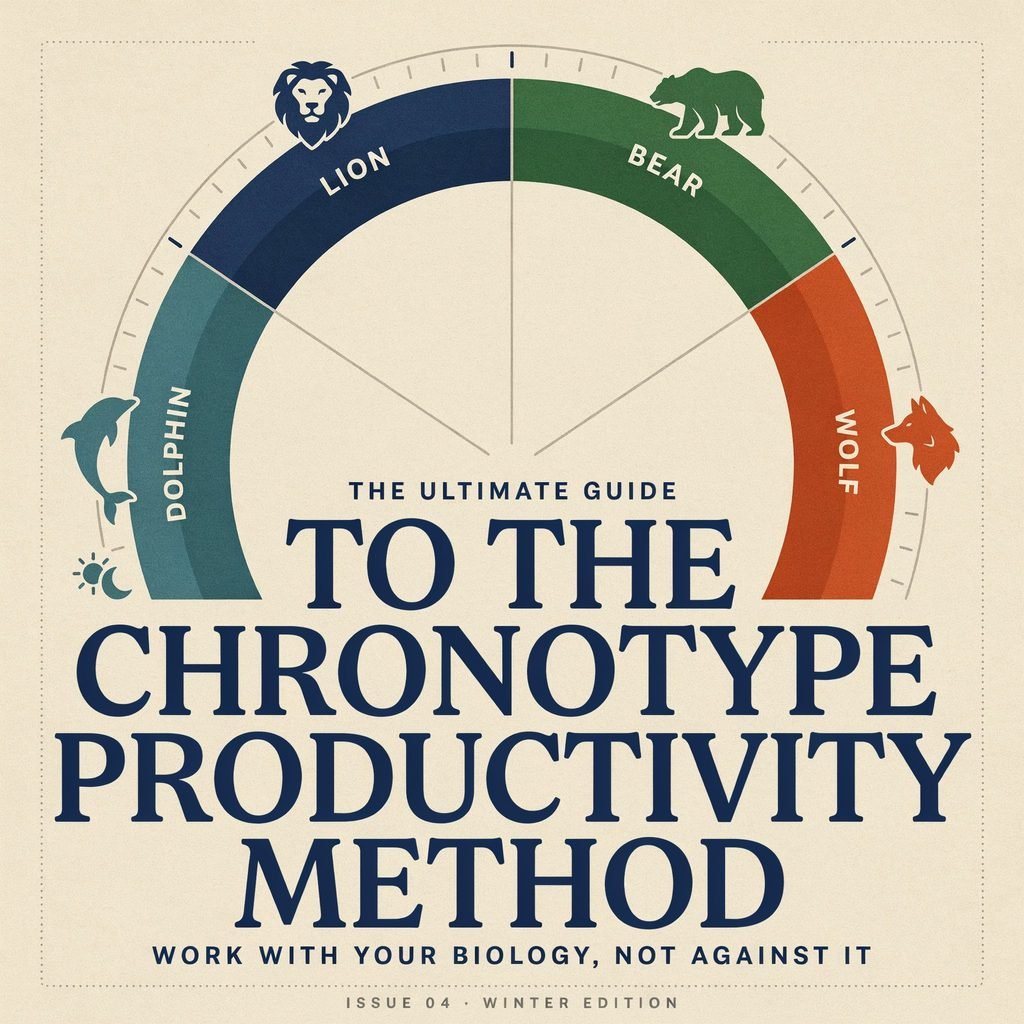
This is why energy management is the ultimate, high-level upgrade to basic scheduling. You need to identify your unique “Chronotype.”
Are you a morning lark who thrives at dawn with a cup of coffee? Or are you a night owl who finally hits your creative stride after the kids go to bed?
Align your most difficult, brain-heavy tasks with your peak energy windows. Save the easy, administrative batching for your natural biological slumps.
When your energy aligns perfectly with your schedule, overcoming procrastination becomes incredibly easy. You simply do not have the friction of fighting your own biology.
The Modern Pomodoro Technique
When you inevitably hit a wall, use the Pomodoro Technique to rebuild your momentum. Work with intense, distraction-free focus for 25 to 50 minutes.
Then, force yourself to take a genuine 5 to 10-minute break. Step away from the glowing screen, stretch your legs, or grab a cold glass of water.
This sustainable rhythm prevents mental fatigue and keeps your cognitive engine running smoothly all day long without burning out.
Finally, protect your precious energy by setting ironclad boundaries. Learn to confidently say no to non-essential commitments that drain your reserves.
Turn off non-urgent push notifications on your smartphone. Close your home office door when it is time for deep, uninterrupted work.
Remember, guarding your energy is not selfish. It is the absolute prerequisite for showing up fully for your career, your family, and yourself.
Conclusion & Your “Day 1” Action Plan
Learning how to organize your life is not about achieving robotic, stressful perfection. It is about building a resilient, forgiving system that supports your unique lifestyle.
You will absolutely have messy days. You will fall off the wagon and eat pizza on the couch instead of meal prepping. That is completely normal and part of the human process.
The goal is simply to be 1% better every single day. Small, consistent adjustments compound into massive, life-altering transformations over time.
Do not try to implement all five steps at once. That is a guaranteed recipe for immediate cognitive overload and total burnout.
Pick just ONE step from this guide to implement today. Start with a 3-day time audit, or try the 1-3-5 rule tomorrow morning.
Take a deep breath. You have the tools, the blueprint, and the power to take back your time. Let’s get organized!