Why Big Projects Feel Impossible
Picture this: it’s 9:47 a.m. on a Tuesday. You’re a freelancer in Austin, and a client just confirmed they need a 60-page market research report by Friday. You open a blank doc. You close it. You open it again. You check your email. You reorganize your desk. An hour evaporates, and you’ve written exactly zero words.
Or maybe you’re a grad student in Chicago, six weeks into a semester-long capstone project. Every Sunday night you tell yourself, “Tomorrow, I’ll really dig in.” Tomorrow becomes next week. Next week becomes the panic spiral at 2 a.m. in April.
Or you’re a side-hustler in Atlanta who’s been meaning to redesign your website for eight months. Eight. Months. The tab with your hosting dashboard is still open. You’ve bookmarked fourteen tutorials. You haven’t changed a single headline.
Here’s the truth nobody tells you: this isn’t laziness. It’s overwhelm from size and vagueness. Your brain looks at “write 60 pages” or “rebuild entire website” and registers a threat. The task is so large, so undefined, that starting feels like stepping off a cliff. Mental resistance to complex work kicks in, and procrastination on big projects becomes your default.
The usual advice doesn’t fix it. “Just start!” Sure, but where? A to-do list that says “work on thesis” isn’t a plan—it’s a guilt trigger. Rigid time-blocking falls apart the moment life interrupts. You don’t need another three-hour focus session you’ll never take. You need a way to make progress that feels almost too small to resist.
That’s where the Swiss Cheese method comes in.
What Is the Swiss Cheese Method?
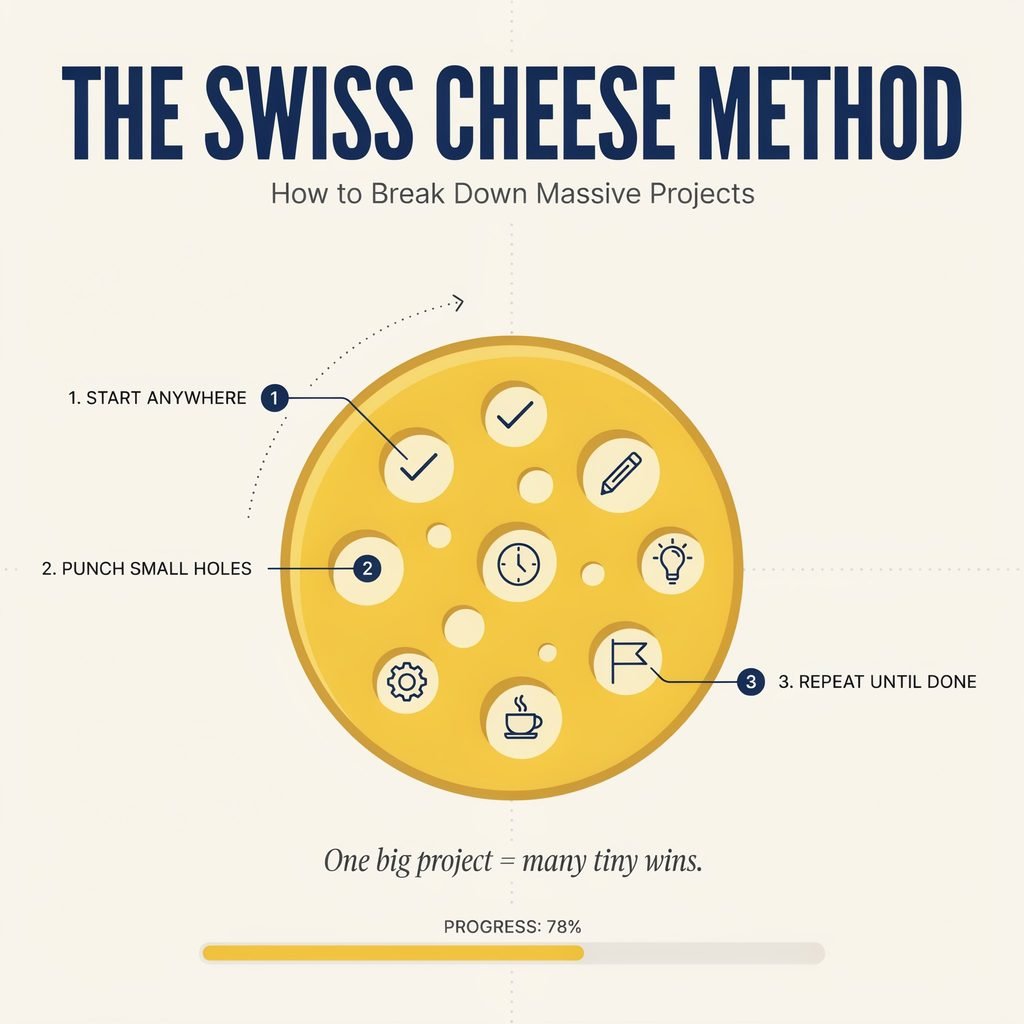
The Swiss Cheese method is a task decomposition technique with one beautifully simple premise: instead of trying to swallow a massive project whole, you poke tiny “holes” through it until it’s riddled with progress.
Think of a block of Swiss cheese. You’re not eating the whole thing in one bite. You’re punching out small, manageable pieces—each one a micro-task so specific and so easy that starting requires almost zero willpower.
Each “hole” is a small, concrete action that takes roughly 2 to 10 minutes and moves the project forward in some visible way. “Open the document and type the title.” “Write three bullet points.” “Email one person and ask one question.” That’s a hole.
A quick clarification, because this trips people up: the Swiss Cheese method for productivity is not the Swiss Cheese Model from risk management (James Reason’s safety framework about layers of defense). This is a practical time-management and task-breakdown strategy, popularized by productivity writer Alan Lakein in the 1970s and refined by decades of time-management literature since.
The core idea is deceptively simple:
- You don’t need a perfect four-hour focus block.
- You don’t need to feel motivated.
- You just commit to one micro-action that feels almost laughably easy.
And here’s the magic: once you poke the first hole, the second one gets easier. Then the third. Momentum builds not because you forced yourself, but because you lowered the activation energy so far that starting stopped being scary. You overcome procrastination on big tasks not by white-knuckling through them, but by making the first step so small your brain can’t say no.
For anyone looking to break down large projects without spiraling into planning paralysis, this is one of the most forgiving productivity frameworks out there.
Why It Works: The Psychology Behind Poking Holes
You might be thinking, “How can a two-minute task actually move a 40-page project?” Fair question. The answer lives in a few well-documented psychological principles.
Activation energy. Chemistry teaches us that a reaction needs a spark to get going. Your brain works the same way. “Write the introduction to my thesis” requires a huge psychological spark. “Open the doc and write three ugly sentences” requires almost none. When you shrink the task to 2–10 minutes, you reduce cognitive load for complex work and your brain stops treating the task like a threat.
The progress principle. Research from Harvard Business School (Amabile & Kramer, 2011) shows that the single biggest driver of motivation at work is the feeling of making progress—even tiny progress. Each hole you poke registers as a win. Small wins productivity isn’t a buzzword; it’s a neurological feedback loop. You feel forward motion, so you want more of it.
Cognitive load reduction. A vague, massive project occupies mental RAM 24/7. You carry it to bed. You carry it into meetings. Breaking it into defined micro-tasks offloads that mental clutter. You stop juggling “the whole thing” in your head and start juggling one concrete, finishable action.
Momentum and identity shift. This one’s underrated. Every completed hole quietly rewrites your self-narrative. You go from “I’m someone who avoids this project” to “I’m someone who pokes holes in it every day.” Build momentum on long-term projects by stacking evidence that you show up.
Consider the difference:
- ❌ “Redesign website” → paralyzing, vague, infinite.
- ✅ “List five homepage sections that need updating” → done in four minutes with a sticky note.
- ❌ “Write the introduction” → abstract, high-pressure.
- ✅ “Open the document and write three ugly sentences” → done before your coffee cools.
That’s the psychology of task breakdown in action. You’re not tricking yourself. You’re designing a starting point your brain will actually accept.
Step-by-Step: How to Use the Swiss Cheese Method on Any Massive Project
Here’s a repeatable, practical productivity framework you can apply to a website launch, a thesis, a business plan, a home renovation—any project that’s been sitting on your shoulders for weeks.
Step 1: Define the “Block” (Your Massive Project)
Write your project as one clear outcome sentence with a deadline.
- ✅ “Launch a 10-page service website by December 1.”
- ✅ “Complete a 40-page research paper by finals week.”
- ❌ “Work on website.” (Too vague.)
- ❌ “Do school project.” (Meaningless.)
If you can’t write the outcome in one sentence, you haven’t defined the block yet. Get specific before you poke anything.
Step 2: Identify Natural “Layers” or Phases
Break the project into 3–6 major phases. These aren’t tasks yet—they’re chunks.
- Research → Outline → Draft → Edit → Publish
- Strategy → Design → Content → Build → Launch
- Topic selection → Literature review → Data collection → Writing → Formatting → Submission
Keep them high-level. Five phases is plenty. This step should take you three minutes, not three hours.
Step 3: Poke Your First Holes (Micro-Tasks)
For each phase, ask yourself one question:
“What is the smallest, dumbest, easiest action I could do in 2–10 minutes that moves this forward?”
Examples of holes:
- “Open a new doc and title it ‘Client Report – Draft 1.'”
- “Write three bullet points for the introduction.”
- “List 10 possible subheadings.”
- “Email one colleague and ask a single clarifying question.”
- “Bookmark five competitor pages for inspiration.”
The key rule: holes should feel almost laughably easy. If a micro-task makes your chest tighten, it’s too big. Shrink it. “Write article” is not a hole. “Write the first two sentences of paragraph one” is a hole.
Step 4: Schedule Hole-Poking Sessions
You don’t need a sacred two-hour block. Use the time pockets you already have:
- 1–3 holes per day, tucked between meetings or errands.
- Morning coffee: one hole before you open email.
- Post-lunch slump: one hole when your brain is too foggy for deep work.
- “If-then” rules: “If I’m waiting for a Zoom call to start, I’ll poke one hole.”
Want structure? Pair this with Pomodoro—one hole per 25-minute timer. But the method works just as well in five-minute gaps. This is practical time management for US professionals whose calendars look like a game of Tetris.
Step 5: Track Holes and Celebrate Micro-Wins
Keep a dead-simple log:
- A checklist in your notes app.
- A sticky note on your monitor.
- A running doc: date + hole completed.
Visually crossing things off matters. It combats the “I did nothing all day” feeling that haunts anyone working on long, sprawling projects. You did do something. Three somethings. Write them down. Let yourself feel the small win.
Step 6: Let Holes Reveal the Next Holes
Here’s the beautiful part: you don’t need to plan every micro-task upfront. As you complete holes, new ones appear naturally.
- Hole: “List homepage sections” → reveals → “Write draft copy for the Hero section.”
- Hole: “Find five PDFs” → reveals → “Summarize key argument from Article #2.”
The project gradually defines itself. You create small tasks from large goals in a self-sustaining loop. No 47-step Gantt chart required. Just the next hole, and the one after that.
Real-World Examples: Swiss Cheese in Action
Let’s make this concrete with three scenarios you might recognize.
Example 1: Freelancer Launching a Niche Site
Project: “Launch a 15-article affiliate site in 90 days.”
Holes (each one 2–10 minutes):
- Buy the domain and set up hosting. (Done Tuesday over lunch.)
- Install a WordPress theme and change the site title. (Wednesday, while waiting for a client call.)
- Write five headline ideas for Article #1. (Thursday morning, coffee in hand.)
- Outline the intro + three H2 subheadings for Article #1. (Friday, post-gym.)
No single session lasted more than ten minutes. By end of week one, the site exists, the theme is live, and the first article has a skeleton. Breaking down website launch tasks into micro-steps turned a 90-day mountain into a gentle staircase.
Example 2: College Student with a Capstone Project
Project: “Submit a 40-page senior thesis by May 1.”
Holes:
- Email professor with three topic ideas. (Done from bed, 8 a.m.)
- Find and save five PDFs related to Topic A. (Between classes.)
- Write a messy 200-word summary of Article #1. (Library, 20 minutes before a lecture.)
- Draft three research questions in bullet form. (Sunday evening, one Pomodoro.)
This student project task breakdown means the thesis stops being a terrifying monolith and becomes a series of Tuesday-afternoon actions. No all-nighters required.
Example 3: Side-Hustler Building a Portfolio
Project: “Create a design portfolio with 6 case studies.”
Holes:
- Pick the 6 projects to include (just list names). (Five minutes.)
- Write 3 bullet points for Project #1’s challenge section. (While dinner’s in the oven.)
- Export 3 images from Project #2. (Waiting for a file to render.)
- Choose a color palette for the portfolio template. (Saturday morning, still in pajamas.)
Portfolio project micro-steps like these mean you’re not staring at a blank portfolio builder wondering where to begin. You already have content. You just need to poke a few more holes.
Common Mistakes & How to Avoid Them
The Swiss Cheese method is forgiving, but a few pitfalls can blunt its edge. Watch for these:
- Making holes too big. “Write the article” is not a hole. “Write the intro paragraph” is. If a task takes more than 10 minutes or makes you hesitate, split it again. How to make micro-tasks smaller: remove every adjective, narrow the scope, lower the quality bar.
- Over-planning instead of poking. Don’t spend two hours designing the “perfect” tracking system or color-coding your phases. That’s avoidance wearing a productivity costume. Pick one hole. Do it. Then pick another.
- Ignoring emotional resistance. If a hole still feels heavy, it’s still too big. Shrink it until it feels almost silly. “Open the file” is a valid hole. “Read one paragraph” is a valid hole. Meet yourself where you are.
- Only poking holes, never connecting them. Eventually, those scattered holes need to form a coherent deliverable. Build in a weekly “assembly” session where you stitch pieces together into a draft, a section, a finished product. Holes create paths—but you still walk the path.
- Perfectionism. Holes are allowed to be ugly. Three bad sentences are better than zero perfect ones. Editing is a later phase. Give yourself permission to poke messy holes. Perfectionism and big projects are a toxic pair; micro-tasks break the spell.
When to Use (and Not Use) the Swiss Cheese Method
Best for:
- Large, open-ended, long-term projects (websites, theses, business plans, renovations).
- Tasks you keep avoiding because they feel too big, too vague, or too intimidating.
- People with irregular schedules, parents, freelancers juggling clients—anyone who can’t guarantee a three-hour deep-work block.
- The early “getting unstuck” phase of any project.
Less ideal for:
- Very small, one-off tasks. If it takes 12 minutes total, just do it. Don’t poke a hole in a sticky note.
- True emergencies requiring immediate, sustained focus (a server outage, a same-day client deliverable). Those need a sprint, not a slow poke.
Think of the Swiss Cheese method as one tool in a broader productivity toolkit for large projects. Pair it with time-blocking for assembly sessions. Use Pomodoro for structure. Borrow “Eat the Frog” for your hardest hole of the day. Run a weekly review to connect holes into finished work. Combine Swiss Cheese with Pomodoro, and you’ve got a flexible system that adapts to real life.
Quick-Start Checklist: Poke Your First 5 Holes Today
Ready to start the Swiss Cheese method today? Grab a pen or open a blank note. Here’s your quick productivity checklist:
- Choose one massive project you’ve been avoiding. (Yes, that one.)
- Write it as a single outcome sentence with a deadline.
- Break it into 3–5 phases. Keep it rough. Three minutes max.
- For each phase, define one 2–10-minute hole. Make it almost embarrassingly easy.
- Schedule time in the next 24 hours to complete at least 2 holes. Put it in your calendar. Treat it like a meeting.
- Track them visibly. Check them off. Let yourself see the progress.
That’s it. No app. No 30-day challenge. No accountability partner you’ll never text back. Just you, five tiny holes, and a project that finally starts moving.
One last thing: tell someone your first hole. Text a friend. Post it. Say it out loud to your cat. “I’m going to open the doc and title it.” Externalizing that micro-commitment makes it real. And when you finish, you get to say, “Done.”
That feeling? That’s momentum. And momentum is how massive projects actually get finished—not in one heroic sprint, but one small, cheesy hole at a time.
Now go poke yours.