You open your inbox and see a three-sentence email that needs a quick reply. You glance at the dishwasher and think, I’ll load it after this show. You promise yourself you’ll schedule that dentist appointment, file that receipt, fold the laundry on the chair, or write the opening line of a report—tomorrow. Tomorrow becomes next week. Next week becomes a growing pile of tiny obligations that whisper at the back of your mind every time you sit down to focus.
Sound familiar? You are not lazy. You are dealing with minor procrastination: the habit of postponing quick, low-effort actions that genuinely take very little time or energy. It is not the same as burnout, clinical anxiety, ADHD-related executive dysfunction, or facing a workload that is genuinely too large for one person. It is the everyday friction of small tasks piling up because “later” always feels easier than “now.”
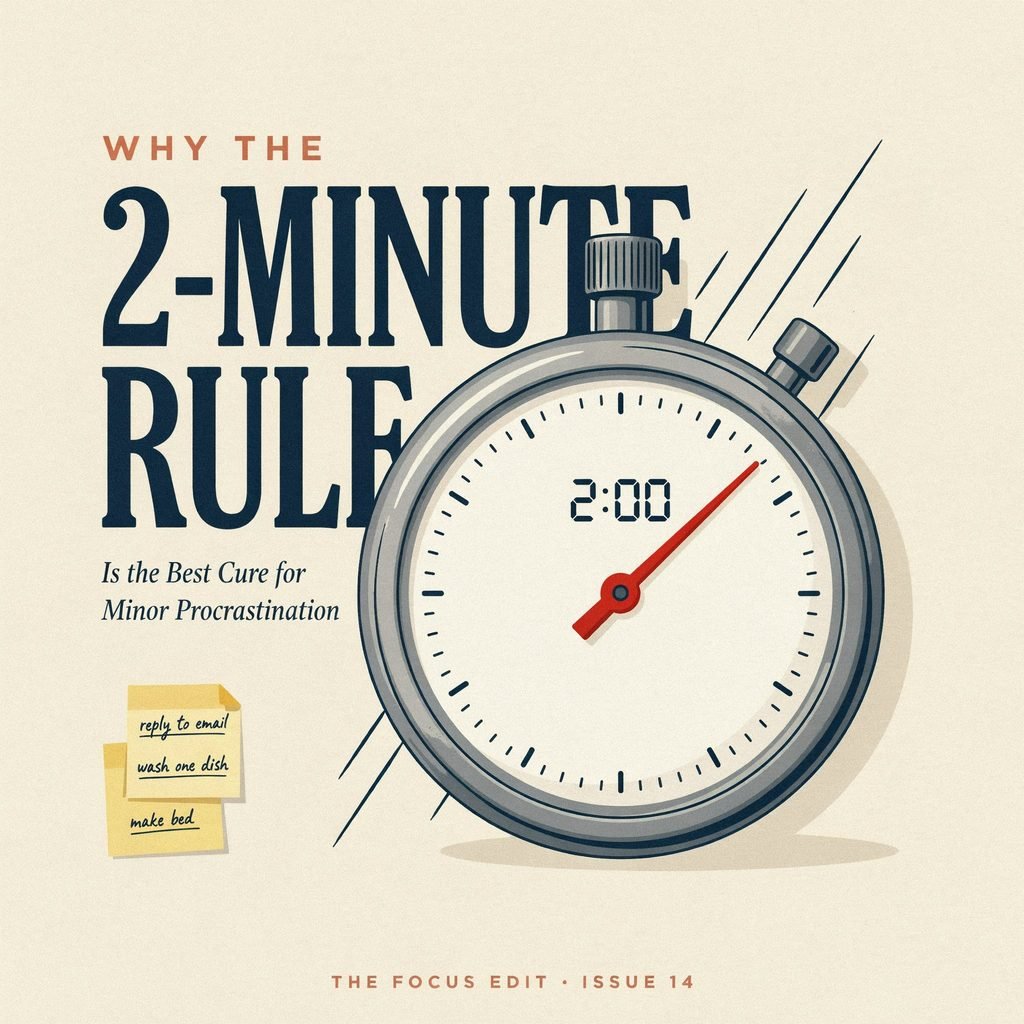
The 2-Minute Rule is a simple productivity method designed to break exactly that pattern. The core principle has two parts:
- If a task takes two minutes or less, do it immediately.
- If a larger task feels difficult to start, shrink it down to a two-minute starting action.
That is it. No complex productivity system. No color-coded planner. Just a clear, actionable rule that lowers the barrier between intention and action.
What Is the 2-Minute Rule?
The 2-Minute Rule is a behavioral shortcut that removes the decision-making step between noticing a task and completing—or beginning—it. It connects directly to research on habit formation, task initiation, and the psychology of momentum. When you eliminate the “should I do this now or later?” question, you bypass the mental negotiation that lets procrastination habits take root.
Two well-known interpretations of the rule exist, and both are useful in different situations.
David Allen’s “Getting Things Done” Version
In his classic book Getting Things Done, productivity consultant David Allen popularized a straightforward guideline: during your daily workflow, if the next action on your list takes fewer than two minutes, complete it on the spot rather than adding it to your to-do list. The logic is practical. Writing the task down, remembering it, returning to it, and gathering context later often takes more time than simply handling the quick task right now.
This version shines for busy professionals, remote workers juggling Slack messages and emails, and parents managing a stream of small household admin. It keeps your to-do list lean and prevents quick tasks from snowballing into mental clutter.
James Clear’s Habit-Building Version
In Atomic Habits, author James Clear adapts the concept for long-term behavior change. His rule says: when you want to build a new habit, scale it down until it takes two minutes or less to begin. Want to read every night? Start by reading one page. Want to run three times a week? Start by putting on your running shoes and stepping outside.
This version targets the hardest moment in any new routine—the first few seconds of task initiation. By making the starting action almost absurdly small, you reduce resistance and give yourself a small win that makes the next step feel natural.
Both interpretations share a common insight: lowering the activation energy of a task makes action feel easier than avoidance.
Why Small Tasks Create Big Problems
A single unwashed coffee mug is not a crisis. But fifteen unwashed mugs, three unanswered emails, an unfiled tax document, and a dentist appointment you have been meaning to schedule for a month? That is a different story.
Minor procrastination compounds. Each delayed task occupies a small slice of working memory. Psychologists sometimes call this the Zeigarnik effect—unfinished tasks tend to linger in your mind more than completed ones. Over a day or a week, those lingering fragments create:
- Mental clutter. Your brain keeps a background tab open for every postponed item, stealing focus from whatever you are actually trying to do.
- Decision fatigue. Every time you glance at the pile and decide not yet, you spend a tiny amount of willpower. Multiply that by twenty small tasks and you feel drained before lunch.
- An intimidating to-do list. Ten two-minute tasks look easy individually. Listed together, they morph into a wall that feels overwhelming.
- Low-level guilt. The vague sense that you “should” be doing something erodes your confidence and makes you avoid the list entirely.
For work-from-home professionals especially, the boundary between “quick chore” and “deep work” blurs. A cluttered kitchen counter or an overflowing inbox can quietly sabotage productivity at work without you realizing why.
Why Starting Is the Hardest Part
Most people who struggle with procrastination habits do not actually dislike the task itself. They dislike the transition from resting, scrolling, or doing something comfortable into effortful action. That transition—task initiation—carries a small emotional cost. Your brain prefers the known comfort of the present moment over the mild uncertainty of beginning something new.
The 2-Minute Rule works because it shrinks that emotional cost to almost nothing. “Write the entire quarterly report” feels heavy. “Open the document and type the title” feels trivial. Once you have crossed the starting threshold, continuing is far easier than you predicted. You are no longer deciding whether to act. You are already in motion.
How Quick Wins Build Momentum
Completing a small task releases a modest hit of satisfaction. You check something off. You see a visible result. That small win does three things:
- It reduces resistance for the next task. You have already proven to yourself that you can act.
- It builds confidence. Each completed item quietly reinforces the identity of someone who gets things done.
- It creates behavioral momentum. Physicists talk about objects in motion staying in motion. The same principle applies to productivity. One finished email makes the second email easier to open.
Over days and weeks, these micro-wins become simple productivity habits. You stop negotiating with yourself about whether to load the dishwasher because the two-minute window makes the question irrelevant. You build better habits not through grand overhauls but through repeated, tiny acts of follow-through.
2-Minute Rule Examples
The table below shows how the rule applies across everyday areas of life for a US-based reader.
| Area of Life | Delayed Task | Two-Minute Action |
|---|---|---|
| Work | Reply to a simple email | Write and send a three-sentence response |
| School | Start an assignment | Open the document and write the heading |
| Home | Messy kitchen | Put five items into their proper place |
| Fitness | Skipping workouts | Put on workout clothes and do one stretch |
| Money | Avoiding bills | Open the billing app and check the due date |
| Digital organization | Cluttered inbox | Archive or delete five emails |
Notice that none of these actions require motivation, special equipment, or a large block of time. They only require a decision to begin.
Turning Larger Tasks into Two-Minute Starter Steps
Not every responsibility fits inside two minutes. Filing taxes, writing a research paper, or deep-cleaning the garage are genuinely larger projects. The 2-Minute Rule still helps here by converting a daunting project into a tiny first step.
- Quarterly tax prep → Open your tax software folder and locate last year’s return.
- Ten-page college essay → Create a blank document and type the essay prompt at the top.
- Garage cleanout → Set a timer for two minutes and sort one single shelf.
- Applying for a new job → Open the job listing and highlight three key requirements.
The goal is not to finish the project in two minutes. The goal is to eliminate the paralysis of starting. Once you begin, you can choose to continue—or you can stop knowing you made progress. Either way, the task no longer sits untouched on your to-do list generating low-grade stress.
A Simple Step-by-Step Process for Daily Use
Ready to turn the 2-Minute Rule into part of your daily routine? Follow these actionable steps:
- Scan your environment once each morning. Glance at your inbox, kitchen counter, desk, and calendar. Notice anything that would take under two minutes.
- Do it or schedule it. If the task truly takes two minutes or less, handle it before moving on. If it is bigger, write down a two-minute starter step.
- Set one “starter step” for your most-avoided task. Shrink it until it feels almost too easy.
- Use transitions as triggers. Before you open social media, before lunch, before your next meeting—pause and ask, “Is there a two-minute task I can knock out?”
- Track small wins briefly. A simple tally mark on a sticky note or a checkmark in your notes app reinforces the habit loop.
This process takes almost no extra time and fits naturally into time blocking or any existing productivity system you already use.
Common Mistakes to Avoid
The 2-Minute Rule is a tool, not a lifestyle philosophy. A few missteps can blunt its effectiveness:
- Using it to dodge deep work. If you spend your entire morning answering twelve two-minute emails, you may feel productive while avoiding the ninety-minute focused block your project actually needs. Protect time for deep work first; let quick tasks fill natural gaps.
- Treating every task as urgent. Not everything requires an instant response. If a task is genuinely low-priority and can wait until a batch-processing window, schedule it. The rule targets tasks you are avoiding, not tasks you are managing well.
- Multitasking through quick tasks. Doing five two-minute tasks simultaneously often means none gets full attention. Handle them sequentially.
- Overloading your day with tiny tasks. If your calendar is nothing but micro-tasks, step back and examine your task prioritization. A productivity method should reduce overwhelm, not create a new form of busywork.
- Ignoring the “larger task” half of the rule. Only using the rule for genuinely tiny tasks misses the bigger benefit: shrinking intimidating projects into approachable first steps.
When the 2-Minute Rule Isn’t Enough
The 2-Minute Rule is a procrastination solution for minor, everyday delays. It is not a cure-all, and it is important to be honest about its limits.
If you face a genuinely overwhelming workload, no amount of two-minute starts will fix a staffing or boundary problem. You may need delegation, a conversation with a manager, or a structural change in how work is distributed.
If procrastination is accompanied by persistent difficulty focusing, chronic avoidance that affects your job or relationships, or feelings of anxiety and depression, the issue may go beyond habit. In those cases, time blocking, professional coaching, cognitive-behavioral strategies, or support from a healthcare provider can make a meaningful difference.
If you are managing ADHD, executive-function challenges, or burnout, the 2-Minute Rule can still be one small tool in a larger toolkit—but pairing it with a structured productivity system, medication management (if prescribed), or therapy often yields better results than any single tip alone.
The rule works best when procrastination is a friction problem, not a capacity problem. Knowing the difference is itself a form of good time management.
Frequently Asked Questions
What is the 2-Minute Rule for procrastination?
The 2-Minute Rule says that if a task takes two minutes or less, you should do it immediately instead of postponing it. For larger tasks, you shrink the first step down to something that takes two minutes or less, making it easier to overcome the initial resistance to starting. It is a simple productivity method aimed at reducing the buildup of small, nagging obligations.
Does the 2-Minute Rule really work?
For minor procrastination—delaying quick, low-stakes tasks—many people find it highly effective because it removes the decision-making step that lets avoidance take hold. It leverages well-understood principles of habit formation, momentum, and reduced activation energy. It works best when applied consistently as part of a broader set of productivity tips rather than as a one-time fix.
What if a task takes longer than two minutes?
You do not need to finish the whole task in two minutes. Instead, identify the smallest possible first action—opening a file, writing one sentence, gathering one document—and do only that. Often, starting dissolves the resistance and you naturally continue. If you stop after two minutes, you have still made progress and broken the avoidance cycle.
Is the 2-Minute Rule useful for ADHD or chronic procrastination?
It can be a helpful micro-strategy for task initiation, but it is not a standalone treatment. ADHD and chronic procrastination often involve neurological, emotional, or environmental factors that go beyond a simple rule. Productivity strategies can support organization, but persistent difficulties with focus, motivation, or follow-through may benefit from support from a qualified healthcare or mental health professional. Consider the 2-Minute Rule one tool among many—not a replacement for personalized care.
Conclusion: Your Next Two Minutes
You do not need a complete life overhaul to stop putting off small tasks. You do not need a new app, a color-coded planner, or a weekend productivity seminar. You need a two-minute window and the willingness to act before your brain talks you out of it.
The 2-Minute Rule works because it meets you where you are: slightly reluctant, mildly distracted, and perfectly capable of doing one very small thing. It transforms “I’ll do it later” into “I’ll do it now” by making “now” feel effortless. And each small win quietly rewires your daily routine, proving that you are someone who follows through.
So here is your invitation. Close this article, look around your workspace or home, and pick one task you have been putting off. Maybe it is replying to that email. Maybe it is putting the laundry in the hamper, opening the billing portal, or writing the first sentence of the thing you have been dreading.
Whatever it is, give yourself two minutes. Start before you feel ready. Finish it if you can, or simply begin.
Two minutes is all it takes to prove to yourself that you can get things done—and that small, consistent action is the most reliable path to lasting focus and motivation.
Now go. Your two minutes start right now.